



Standing in an oil aisle and reading three bottles that all claim to be ‘pure’, ‘natural’, and ‘healthy’ can leave you feeling like you know less than when you started. The terminology on edible oil packaging in India is inconsistently used, partly because regulatory definitions for terms like ‘natural’ and ‘pure’ do not exist in FSSAI standards for edible oils, and partly because marketing departments have learned that health-adjacent words sell.
This guide decodes every significant term you will encounter on an Indian edible oil label, what it means, what it does not mean, and what to look for when the label is being vague.
Start With the Mandatory Information
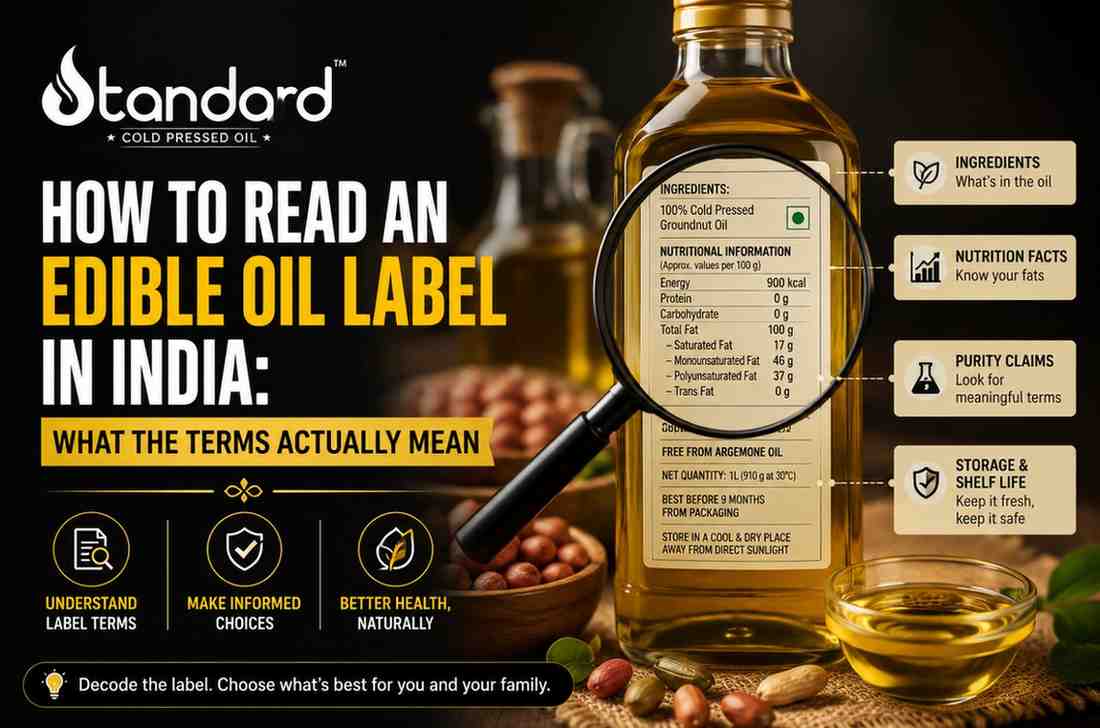
FSSAI (Food Safety and Standards Authority of India) requires specific information on all packaged edible oil labels. These are the items that are legally required and therefore reliable:
FSSAI Licence Number
Every commercially sold packaged food in India must carry the manufacturer’s FSSAI licence number. This confirms the producer is registered and operating under food safety oversight. Absence of this number on a commercially sold product is an immediate concern. Its presence does not tell you about extraction method or processing, it is a baseline legitimacy indicator.
Ingredients List
For a single-ingredient cold pressed oil, the ingredients should list only the oil itself: ‘Cold Pressed Groundnut Oil‘ or ‘Wood Pressed Sesame Oil’. If you see additional items, antioxidants (TBHQ, BHA, BHT), any kind of preservative, or other additives, the oil has been modified from its natural state. TBHQ is the most common synthetic antioxidant in refined Indian cooking oils; its presence tells you the oil was refined enough that its natural antioxidants were depleted.
Net Quantity
Standard. Just confirm what you are buying.
Manufacture Date and Best Before Date
This is a meaningful signal. Cold pressed oils, unrefined and without synthetic antioxidants, have genuinely shorter shelf lives than refined oils. A cold pressed groundnut or sesame oil will typically have a best-before date 12–18 months from manufacture. Cold pressed mustard oil, whose glucosinolate-derived compounds provide some natural stability, lasts similarly.
If a cold pressed oil has a best-before date 24–36 months from manufacture, one of two things is true: the producer has added synthetic antioxidants (check the ingredients list), or the ‘cold pressed’ claim is questionable.
The Terminology That Is Not Regulated (But Matters)
‘Cold Pressed’
The term ‘cold pressed’ indicates that oil was extracted without the application of external heat above a threshold, typically understood as below 49°C. FSSAI has product standards for cold pressed oils under its Food Products Standards and Food Additives regulations, but enforcement and standardisation of the term on labelling are not uniformly applied.
What to check alongside the claim: Does the oil have natural colour? (Cold pressed groundnut oil is golden, not pale.) Does it smell like the seed? (Cold pressed sesame oil smells of sesame, cold pressed mustard oil smells of mustard.) Is the shelf life shorter than refined equivalents? Is there no mention of bleaching, deodorising, or solvent extraction in the brand’s process description?
Brands that genuinely cold press their oils will usually describe their process with some specificity, temperature during extraction, extraction method, absence of solvents. Brands using ‘cold pressed’ loosely tend to provide less process detail.
‘Wood Pressed’ or ‘Kachi Ghani’
These terms refer to traditional wooden press extraction, genuinely the most conservative and low-temperature extraction method. They are a subset of cold pressed. However, ‘kachi ghani’ has become a marketing term that some producers apply to any cold or slow-pressed extraction, including metal expeller presses operated at low speed. The sensory indicators mentioned above, colour depth, aroma intensity, flavour, remain your best guide.
‘Expeller Pressed’
Expeller pressing uses mechanical force without solvents. Temperature during extraction depends entirely on the speed of the press and the specific machine. Expeller pressed oil can be cold pressed (if temperature is controlled below 49°C) or hot pressed (if run at higher throughput with resulting higher temperature). Expeller pressed is meaningfully better than solvent-extracted in terms of process, but it is not synonymous with cold pressed.
‘Refined’
Refined means the oil has gone through industrial processing steps including degumming, bleaching, deodorising, and typically solvent extraction. ‘Refined’ and ‘cold pressed’ are mutually exclusive, an oil cannot be both, because refining involves the exact processes that cold pressing avoids. If you see both terms on a label, that is a red flag.
‘Double Filtered’ or ‘Extra Filtered’
Filtration removes particulate matter (seed fragments) from pressed oil. Double filtering means the oil has passed through two filtration stages for greater clarity. This is a purely physical process with no significant impact on oil composition. The term is neutral, neither a quality indicator nor a concern. Cold pressed oil is typically filtered before bottling; more filtering does not mean more processing.
‘No Cholesterol’ or ‘Cholesterol Free’
All vegetable oils are cholesterol-free. Cholesterol is an animal-derived compound. Labelling a vegetable oil as ‘cholesterol-free’ is technically accurate but entirely meaningless as a differentiator. It applies equally to the most heavily refined commercial oil and to the most carefully cold pressed artisanal oil. Treat this label as marketing noise.
‘Natural’ and ‘Pure’
Neither ‘natural’ nor ‘pure’ has a defined regulatory meaning on Indian edible oil labels. A fully refined, solvent-extracted, bleached, deodorised cooking oil can legally be called ‘pure’ because it contains only one ingredient, the oil itself, after everything else has been removed. A product labelled ‘natural’ with no further process description tells you essentially nothing. These words require supporting evidence, process transparency, extraction method detail, to be meaningful.
A Practical Checklist for Evaluating Any Oil Label
- Check the FSSAI licence number, should be present
- Check the ingredients list, single ingredient, no synthetic antioxidants, for a genuine cold pressed oil
- Check the best-before date relative to manufacture date, 12–18 months suggests cold pressed without additives
- Check for colour description or actual colour in the bottle, cold pressed oils have natural colour
- Look for process description on the brand’s website if the label is minimal, reputable cold pressed producers describe how they extract
- Be sceptical of ‘natural’ and ‘pure’ without supporting process detail
- Be wary of a ‘cold pressed’ label combined with neutral colour, odourless character, and a 2–3 year shelf life
| Our labels tell you exactly what is in the bottle and how it was made. We publish our extraction process and believe transparency is non-negotiable.standardcoldpressedoil.com/shop |
Related Reading
- Cold Pressed vs Refined Oil: What Actually Changes in the Process
- Why the Oil Extraction Method Affects What You Are Actually Eating
- How to Store Cold Pressed Oils So They Last Longer
