



There is a version of this question that wants a single clean answer. ‘Use groundnut oil for everything.’ Or: ‘Mustard is the healthiest, just use that.’ Those answers exist online in abundance, and they are not particularly useful.
Indian cooking spans the subcontinent. Bengali mustard-marinated fish and Tamil sesame rice and Kerala fish moilee and Rajasthani dal baati churma and Punjabi sarson da saag, these dishes were developed over centuries in specific regions, using the oils available from local crops and local ghani presses. The regional character of these dishes is inseparable from the oil used in them.
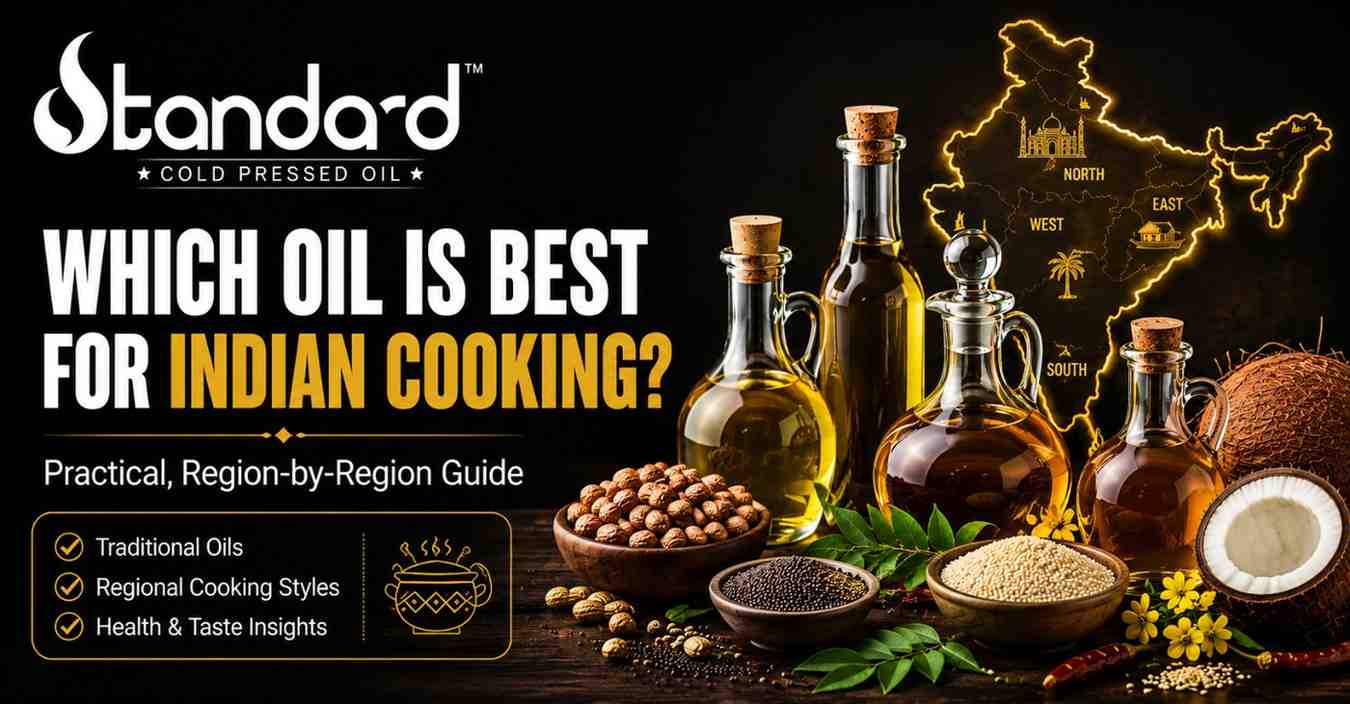
A better answer to ‘which oil is best’ starts with asking: best for which cooking style, which dish, which region, and which cooking method? Let us work through that properly.
Cold Pressed Groundnut Oil: The Most Versatile Everyday Oil
If we are recommending one oil for a household that cooks a wide range of Indian food, cold pressed groundnut oil is the closest to a universal answer.
Its fatty acid profile, approximately 46% oleic acid (monounsaturated), 32% linoleic acid (polyunsaturated), 11% palmitic acid (saturated), gives it reasonable heat stability among cold pressed options. Its smoke point of 160–180°C handles tempering, sauteing, making curry bases, shallow frying, and occasional deep frying without issue. Its flavour is mild enough that it does not dominate dishes the way mustard or sesame would.
Groundnut oil is traditional across South India, Andhra Pradesh, Tamil Nadu, Karnataka, and Telangana all have deep culinary roots in groundnut oil. Gongura pachadi, gutti vankaya curry, chettinad preparations, groundnut oil is the appropriate fat for all of these. In Maharashtra, many traditional preparations use groundnut oil as the primary cooking medium.
For families transitioning from refined sunflower or refined groundnut oil to cold pressed, this is the easiest switch. The flavour adjustment is minimal. The cooking behaviour is familiar. The difference you will notice first is the smell of the oil in the pan, warmer, nuttier, more like actual food.
Cold Pressed Mustard Oil: Essential for North and East Indian Cooking
Mustard oil is not a neutral cooking medium. It is an assertive, flavour-forward ingredient. The cooking traditions of North and East India, Punjab, Haryana, Bihar, West Bengal, Odisha, Assam, are built around this fact.
In Bengali cuisine specifically, mustard oil has a role that no other oil can perform. Machher jhol (fish curry) made with refined oil instead of cold pressed mustard oil is a different dish, milder, less characterful, missing the sharpness that makes the dish what it is. Shorshe ilish, aloo posto, chingri malai curry, all of these require mustard oil’s pungency as a foundational flavour note, not a background one.
The traditional technique in many North Indian preparations involves heating mustard oil to its smoking point before adding ingredients, a practice that mellows the sharp raw pungency into a deeper, rounder flavour. This is not a workaround; it is a deliberate culinary technique that uses the oil’s character to the dish’s advantage.
Cold pressed mustard oil contains allyl isothiocyanate (from glucosinolate breakdown during cold pressing) that gives it its characteristic sharpness. This compound is largely destroyed at refining temperatures, which is why refined mustard oil is much milder. If your mustard oil does not smell pungent when you open it, it is likely refined or processed at temperatures too high for genuine cold pressing.
For raw applications, rubbing into marinating fish, making mustardy salad dressings, the onion-mustard-vinegar pickle base, unheated cold pressed mustard oil delivers the most intense, authentic flavour. Start with small amounts if you are new to it; the palate adjusts quickly.
Cold Pressed Sesame Oil (Gingelly): South India’s Traditional Everyday Fat
Cold pressed gingelly oil, made from white (untoasted) sesame seeds, is the foundational cooking fat for Tamil cuisine, large portions of Andhra and Telangana cooking, and traditional Karnataka preparations. It is not the same as the dark toasted sesame oil used in Chinese and Korean cooking (which is a condiment, not a cooking oil). Cold pressed white sesame oil is lighter in colour, milder in flavour, and suitable for everything from high-heat frying to gentle tempering.
In South Indian cooking specifically, the depth of gingelly oil’s flavour is integral to multiple dish categories. Sesame rice (ellu sadam) is meaningless without it, the sesame-on-sesame flavour is the point. Traditional murukku and other deep-fried snacks made during Diwali and other festivals are fried in gingelly oil as a matter of cultural authenticity. The traditional Ayurvedic practice of Abhyanga (self-massage) uses sesame oil, and many South Indian families use the same food-grade cold pressed gingelly oil for both cooking and body care.
The smoke point of cold pressed white sesame oil sits around 160–175°C, adequate for all everyday cooking and even extended frying at managed temperatures. Its polyphenol content (sesamol, sesamolin, sesamin) gives it natural oxidative stability despite being high in polyunsaturated fats, a property that traditional South Indian cooks have relied on practically for centuries without needing to name the chemistry behind it.
Cold Pressed Coconut Oil: The Kerala and Coastal Kitchen Standard
In Kerala, coconut oil is not a health trend. It is the cooking medium that the entire cuisine was built around. Avial, fish moilee, thoran, sadya preparations, every dish in the Kerala canon was developed with coconut oil as the fat.
Cold pressed coconut oil, virgin coconut oil extracted without heat, has a distinctive sweet, coconut aroma that is present but not overpowering in cooked food. It solidifies below 24°C (completely normal; it liquefies again with minimal warming) and has a smoke point of around 175–200°C in its unrefined form, which handles most cooking applications.
Coconut oil’s high saturated fat content (around 85–90%, predominantly medium-chain triglycerides including lauric acid) means it is heat-stable compared to polyunsaturated-heavy oils. It does not oxidise easily under cooking temperatures, which is one reason traditional Kerala cooking never moved away from it despite the saturated fat controversy that has surrounded coconut oil in Western nutrition circles.
For coastal Tamil Nadu and Karnataka cooking, coconut oil is similarly foundational, fish curries, coconut chutneys made in coconut oil, traditional temple cooking all use it authentically.
In Kerala, coconut oil is not a health trend. It is the cooking medium that the entire cuisine was built around. Avial, fish moilee, thoran, sadya preparations, every dish in the Kerala canon was developed with coconut oil as the fat.
Cold pressed coconut oil, virgin coconut oil extracted without heat, has a distinctive sweet, coconut aroma that is present but not overpowering in cooked food. It solidifies below 24°C (completely normal; it liquefies again with minimal warming) and has a smoke point of around 175–200°C in its unrefined form, which handles most cooking applications.
Coconut oil’s high saturated fat content (around 85–90%, predominantly medium-chain triglycerides including lauric acid) means it is heat-stable compared to polyunsaturated-heavy oils. It does not oxidise easily under cooking temperatures, which is one reason traditional Kerala cooking never moved away from it despite the saturated fat controversy that has surrounded coconut oil in Western nutrition circles.
For coastal Tamil Nadu and Karnataka cooking, coconut oil is similarly foundational, fish curries, coconut chutneys made in coconut oil, traditional temple cooking all use it authentically.
| Explore cold pressed coconut oil: standardcoldpressedoil.com/cold-pressed-coconut-oil |
Building a Two-Oil Kitchen
Most serious Indian cooks keep two oils. A pragmatic approach for most households:
- Primary everyday oil: Cold pressed groundnut oil, handles the full range of Indian cooking without imposing strong flavour
- Regional or dish-specific oil: Cold pressed mustard oil for North Indian and Bengali cooking; cold pressed sesame for South Indian dishes; cold pressed coconut for Kerala-style preparations
This gives you coverage for virtually every Indian cooking scenario without cluttering the pantry. As you cook more, you will develop a feel for which oil elevates which dish, and that feel is what makes food memorable.
| Our full range covers every oil your kitchen needs, all cold pressed, all wood-pressed, all chemical-free.standardcoldpressedoil.com/shop |
Related Reading
- Smoke Points of Common Cooking Oils: What They Mean for Your Kitchen
- Mustard Oil in Indian Cooking: Uses, Flavour, and What to Know
- Sesame Oil in Indian Cooking: Why It Has Been Used for Centuries
