



Most cooking oil comparisons focus on the type of oil, groundnut versus sunflower, sesame versus coconut. We rarely talk about what the same seed produces when it goes through different extraction methods. But that comparison is far more revealing. It explains why two bottles both labelled ‘groundnut oil’ can taste completely different, behave differently in the pan, and look nothing like each other.
Let us go through the entire journey of both, cold pressed and refined, from seed to bottle, step by step.
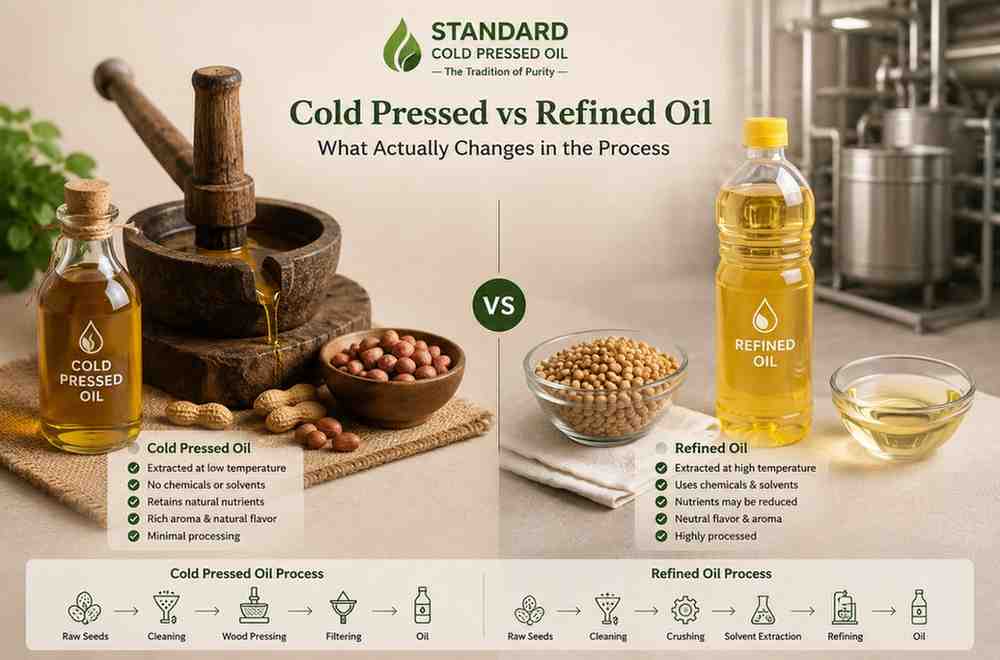
Step 1: The Starting Material Is the Same
Both cold pressed and refined groundnut oil begin with raw peanuts. Both sesame oils begin with the same sesame seeds. The seed variety, the growing region, the harvest quality, these can vary between brands, but the raw material category is identical. What diverges completely is everything that happens next.
Step 2: Pre-Treatment Differences
In industrial oil refining, seeds are typically cleaned, dehulled, and then conditioned: meaning they are pre-heated to increase oil release efficiency. This pre-heating can bring seeds to temperatures between 60°C and 80°C before mechanical pressing even begins. The goal is maximum oil yield.
In cold pressing, seeds are cleaned and fed directly into the press without pre-heating. The press itself runs slowly, particularly in traditional kachi ghani wood-press operations, ensuring that even the friction of extraction does not generate significant heat. The seed goes in at room temperature and the oil comes out at barely above room temperature.
Step 3: The Extraction Itself
Cold pressing uses only mechanical force. A single pass through the press is all the oil gets. What flows out is collected, filtered through a fine cloth or mesh to remove seed particles, and bottled. The entire extraction process takes hours per batch. It is deliberately unhurried.
Industrial refining uses expeller presses running at much higher throughput. After mechanical pressing, the seed cake still contains 8–14% residual oil, too much to leave behind commercially.
his residual oil is extracted by bathing the seed cake in hexane (a petroleum-derived solvent), dissolving the oil out, and then evaporating the hexane off under heat. The combined mechanical and solvent extraction maximises yield and minimises per-litre cost.
The resulting crude oil from industrial extraction is darker, more viscous, and has a strong unpleasant smell, the result of high-heat, high-pressure, and solvent-contact processing. It requires extensive refining before it becomes palatable.
Step 4: Refining Steps That Cold Pressed Oil Never Sees
This is the part most consumers never know about. Industrial crude oil goes through up to six distinct post-extraction processing steps:
Degumming
Removes phospholipids (lecithins) and other gummy compounds using water or acid. Phospholipids are naturally occurring in seed oils and include compounds associated with membrane health. They are removed in refining because they make oil appear cloudy and can cause issues in high-heat frying. Cold pressed oil retains them, which is part of why it sometimes appears slightly hazy.
Neutralisation (De-acidification)
Free fatty acids in crude oil are removed by treatment with sodium hydroxide (lye). The free fatty acids are not inherently harmful, in fact, they contribute flavour, but in industrial oil they cause problems with stability and smoke point, so they are stripped out. The resulting soap stock is a byproduct of this step.
Bleaching
The oil is treated with activated clay or charcoal to remove colour. The natural carotenoids (which give mustard oil its yellow-orange hue and groundnut oil its gold tone) and chlorophyll-adjacent pigments are adsorbed onto the clay and filtered out. After bleaching, the oil is pale and visually neutral.
Those removed carotenoids are not waste, they are the very compounds that give cold pressed oil its visible identity.
Dewaxing
Particularly relevant for sunflower oil. Waxes from the seed coat cause haze at low temperatures. They are removed by chilling the oil and filtering out the crystallised wax particles.
Deodorising
The most transformative step. The oil is subjected to high-temperature steam distillation, typically 200–270°C under vacuum, to strip out all volatile aroma and flavour compounds. This step removes the natural smell of the seed entirely. The pale, odourless, flavour-neutral cooking oil you buy in supermarket bottles exists because of this step.
The same step that removes the pungency from mustard oil, the nuttiness from groundnut oil, and the tropical aroma from coconut oil also removes some of the volatile antioxidants and phytosterols present in the crude oil. Not all, but some.
Antioxidant Addition
Because refining removes the oil’s natural antioxidants (tocopherols, polyphenols), synthetic antioxidants, most commonly TBHQ (tert-butylhydroquinone), BHA, or BHT, are added back to extend shelf life. These are FSSAI-permitted at specified levels. Their presence is disclosed in the ingredients list of refined oils. Cold pressed oil relies on its naturally retained tocopherols for stability and carries no synthetic additives.
What Is Left After Refining?
Fatty acids, primarily. The triglyceride backbone of the oil is largely intact. This is why refined and cold pressed versions of the same oil have roughly similar fatty acid profiles on paper. A nutrition label showing the fat breakdown in grams may look similar for both.
The difference is in everything around those fatty acids, the natural antioxidants, the phospholipids, the carotenoids, the volatile flavour compounds, the phytosterols. These are the elements of the oil that differentiate it from one seed to another, and from one extraction method to another. Refining erases these differences. Cold pressing preserves them.
A Direct Comparison You Can Do at Home
If you have a bottle of refined groundnut oil and a bottle of cold pressed groundnut oil, open both and hold them up to a window. The refined one will be nearly clear. The cold pressed will show colour, golden, warm, slightly amber. Smell the necks of both bottles without tasting. The refined one smells of almost nothing. The cold pressed one smells like peanuts.
That sensory difference is the physical evidence of what the refining process removes.
Neither Is Dangerous. One Is More Natural.
We want to be precise here because it matters. Refined cooking oil is not unsafe. Billions of people consume it daily without incident. FSSAI regulates it, and commercial refined oils in India meet those standards.
What refined oil is, however, is a heavily processed product that starts as a natural seed and ends up looking and smelling like nothing in nature. Cold pressed oil starts as the same seed and ends up tasting, smelling, and appearing very much like that seed in liquid form.
For us, that distinction is the whole point.
| Our full range of cold pressed oils, groundnut, mustard, sesame, coconut, all extracted without solvents, bleaching, or deodorising.standardcoldpressedoil.com/shop |
Related Reading
- What Is Cold Pressed Oil? A Simple Explanation for Everyday Cooks
- Why the Oil Extraction Method Affects What You Are Actually Eating
- How to Read an Edible Oil Label in India: What the Terms Mean
