



Quick Answer
Cold pressed groundnut oil is deep golden, nutty in aroma, and suitable for the full range of Indian cooking including tempering, frying, and curry bases. Its smoke point of 160 to 180 degrees Celsius and high oleic acid content make it the most versatile cold pressed oil for Indian kitchens.
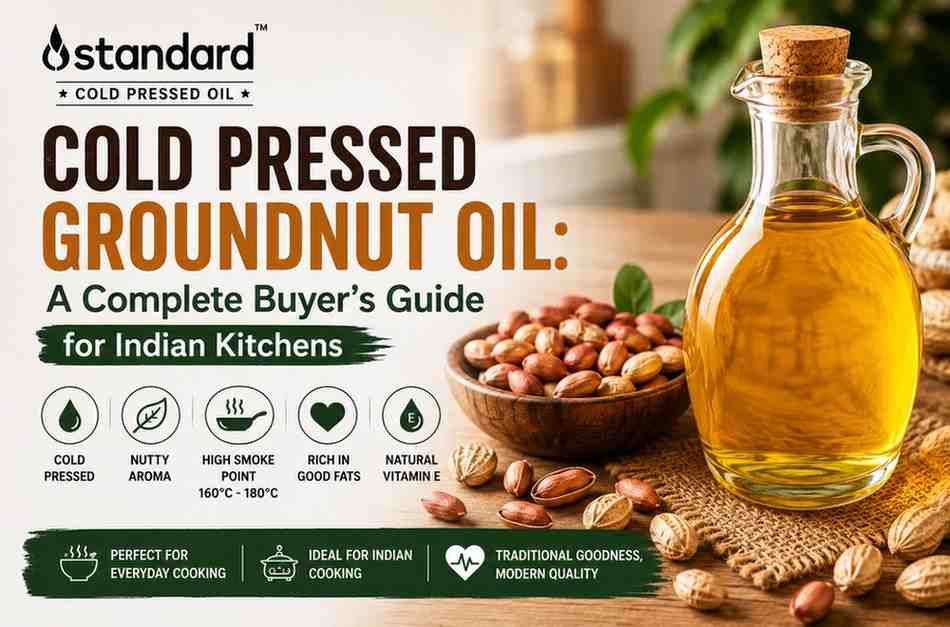
Experience Pure Cold Pressed Groundnut Oil
Enjoy the rich aroma and natural goodness of 100% Cold Pressed Groundnut Oil, traditionally extracted to preserve healthy fats, Vitamin E, and authentic flavour for everyday Indian cooking.
At a Glance
- Smoke point: 160 to 180 degrees Celsius
- Key fatty acids: 46% oleic acid (monounsaturated), 32% linoleic (polyunsaturated)
- Tocopherol content: 400 to 600 mg/kg (cold pressed) vs 150 to 300 mg/kg (refined)
- Traditional names: moongfali tel (Hindi), verkadalai ennai (Tamil), pallelu nune (Telugu), shenga tel (Marathi/Gujarati)
- Best for: South Indian cooking, everyday frying, tadka, curry bases
- Recommended for: First-time cold pressed oil users switching from refined
Groundnut oil has been quietly central to Indian cooking for as long as recorded culinary history goes.
From Andhra Pradesh and Tamil Nadu to Gujarat and Maharashtra, groundnut oil is the workhorse fat that disappears into food without demanding attention. In its cold pressed form, that changes slightly.
Cold pressed groundnut oil has a presence: a genuine roasted peanut aroma and a warm golden colour that refined versions do not carry. But it is still the most versatile traditional Indian cooking oil, which is why it is usually the first we recommend to someone switching from refined.
Fatty Acid Profile: Why It Handles Heat Well
Cold pressed groundnut oil’s fatty acid composition makes it the most balanced cold pressed option for Indian cooking.
| Fatty Acid | Type | Percentage | Cooking Relevance |
|---|---|---|---|
| Oleic acid | Monounsaturated | ~46% | High heat stability, single double bond |
| Linoleic acid | Polyunsaturated | ~32% | More heat-sensitive, protected by tocopherols |
| Palmitic acid | Saturated | ~11% | Stable, contributes to texture |
| Other | Various | ~11% | Minor fatty acids |
The high oleic acid content (similar to olive oil) gives cold pressed groundnut oil relatively good heat stability for an unrefined oil. The natural gamma-tocopherol content, which cold pressing preserves at 400 to 600 mg/kg, protects the linoleic acid portion from oxidising during cooking.
Cold Pressed vs Refined Groundnut Oil: The Comparison That Matters
| Property | Cold Pressed | Refined |
|---|---|---|
| Colour | Deep golden to amber | Pale, nearly clear |
| Smell | Roasted peanut aroma | Odourless |
| Tocopherols | 400 to 600 mg/kg | 150 to 300 mg/kg |
| Additives | None | TBHQ or BHA often added |
| Shelf life (opened) | 3 to 4 months | 12+ months |
| Smoke point | 160 to 180°C | 220 to 230°C |
| Flavour contribution | Yes, warm nutty depth | None |
What Cold Pressed Groundnut Oil Is Best For
Best Oil for Tadka and Tempering
Mustard seeds, curry leaves, dried red chillies, and asafoetida bloom differently in an oil that carries flavour. The foundational tempering for South Indian dal, sambar, kootu, and rice dishes benefits from an oil contributing to rather than diluting the flavour base.
Best Oil for Indian Deep Frying
Groundnut oil‘s smoke point of 160 to 180 degrees Celsius handles home frying comfortably. Murukku, chakli, bhajiyas, medu vada, pakoras, and boondi fried in cold pressed groundnut oil carry a warm nuttiness that neutral refined oil cannot replicate.
Best Oil for Dosa and Tawa Cooking
Cold pressed groundnut oil on a cast iron tawa seasons the surface while adding a mild flavour to dosas. Its smoke point is adequate for the medium-high heat dosa requires, and the nutty note complements the fermented batter.
Curry Bases and Everyday Cooking
For onion-tomato-spice curry bases, groundnut oil provides a neutral enough canvas that the spices lead while the oil contributes subtle warmth. It suits virtually all South Indian, West Indian, and Central Indian everyday cooking.
Groundnut Oil in Regional Indian Cooking
- Andhra Pradesh and Telangana: gutti vankaya, gongura pachadi, pesarattu, groundnut oil is the traditional fat throughout
- Tamil Nadu: Chettinad preparations, kootu, poriyal, gingelly and groundnut oil share the cooking load
- Maharashtra: varan-bhat, thalipeeth, misal pav, shenga tel (groundnut oil) is the default fat
- Gujarat: dhokla, thepla, undhiyu, Kathiawadi preparations, groundnut oil from locally grown peanuts
How to Identify Genuine Cold Pressed Groundnut Oil
- Colour is deep golden to amber, not pale or clear
- Smell distinctly of roasted peanuts when you open the bottle
- Best-before date 12 to 18 months from manufacture, not 2 to 3 years
- Ingredients list shows only groundnut oil, no additives
- May show slight natural haze or sediment, normal in genuinely cold pressed oil
| Wood-pressed, genuinely golden, and made for the full range of Indian cooking. |
Related Reading
- Cold Pressed vs Refined Oil: What Actually Changes in the Process [Blog 2]
- Smoke Points of Common Cooking Oils [Blog 8]
- Groundnut Oil for Deep Frying: What Makes It a Traditional Choice [Blog 16]
Frequently Asked Questions
What is the best oil for dosa?
Cold pressed groundnut oil is well-suited for dosa. It has a smoke point of 160 to 180 degrees Celsius, handles tawa temperatures well, and adds a mild nutty flavour that complements the fermented rice and lentil batter. Cold pressed sesame oil (gingelly oil) is the traditional South Indian alternative.
Is cold pressed groundnut oil good for deep frying?
Yes. Its smoke point of 160 to 180 degrees Celsius is adequate for home frying at 160 to 175 degrees Celsius. Its high oleic acid content and natural tocopherol antioxidants make it more stable during home frying sessions than polyunsaturated-heavy oils like refined sunflower.
What is the difference between cold pressed and refined groundnut oil?
Cold pressed groundnut oil is deep golden, smells of roasted peanuts, and retains natural tocopherols (400 to 600 mg/kg). Refined groundnut oil is pale, odourless, has lower tocopherol content (150 to 300 mg/kg), and usually contains added synthetic antioxidants like TBHQ.
What is shenga tel?
Shenga tel is the Marathi and Gujarati term for groundnut oil. Shenga means peanut or groundnut in Marathi. It is widely used in Maharashtra and Gujarat as the primary everyday cooking oil.
What is verkadalai ennai?
Verkadalai ennai is the Tamil term for groundnut oil. Verkadalai means peanut in Tamil. It is used across Tamil Nadu, particularly in Chettinad cuisine, and is equivalent to moongfali tel in Hindi-speaking regions.
How long does cold pressed groundnut oil last after opening?
3 to 4 months when stored in a cool, dark place away from heat and light. Refrigeration extends this. Rancid groundnut oil smells metallic or sour, which is the reliable indicator to discard it.
