



Quick Answer
Cold pressed coconut oil (virgin coconut oil) has a smoke point of 175 to 200 degrees Celsius, is predominantly saturated fat, and is the traditional cooking fat of Kerala cuisine. It solidifies below 24 degrees Celsius, which is normal. Refined coconut oil has no aroma and is a different product.
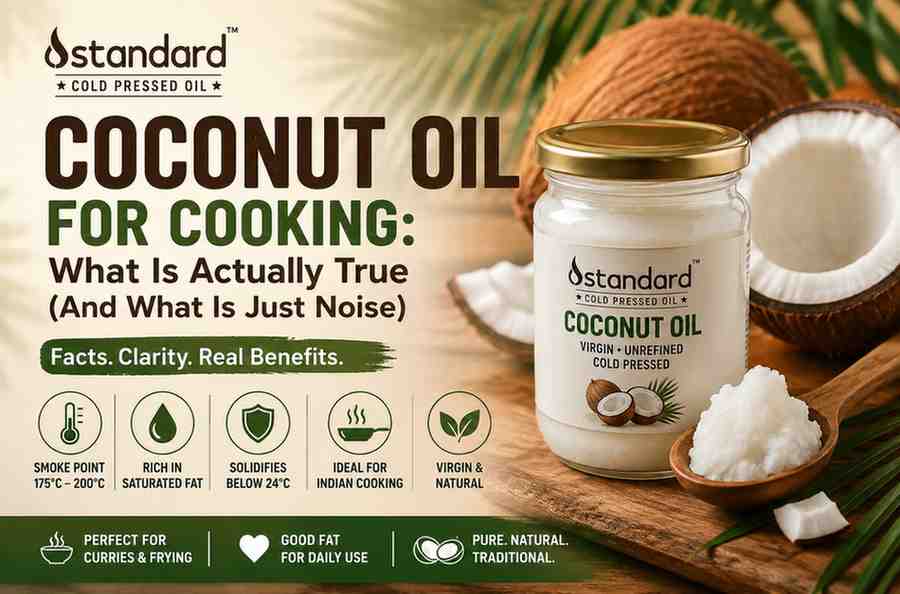
Experience Pure Cold Pressed Coconut Oil
Bring home the natural goodness of 100% Virgin Cold Pressed Coconut Oil. Traditionally extracted to preserve its rich aroma, natural nutrients, and authentic taste for everyday healthy cooking.
At a Glance
- Smoke point: 175 to 200 degrees Celsius (virgin cold pressed)
- Fat composition: 85 to 90 percent saturated fat (MCTs)
- Dominant fatty acid: lauric acid, approximately 47 percent
- Solidifies below: 24 degrees Celsius (completely normal)
- Best for: Kerala cuisine, coconut-based curries, medium to high heat cooking
- Regional names: velichenna (Kerala), thengai ennai (Tamil Nadu)
Coconut oil has had a strange few decades in nutrition discussion.
In the 1980s and 1990s, it was condemned for its saturated fat content. In the 2010s, it was celebrated as a superfood. Neither the condemnation nor the celebration was quite accurate.
For Kerala and coastal South India, this debate was largely irrelevant. Coconut oil has been used continuously for centuries in these kitchens. The cooks who built Kerala cuisine were not making a health or anti-health choice. They were cooking with the fat their land produced.
The Saturated Fat Situation: What Is Actually Known
Coconut oil is 85 to 90 percent saturated fat. This is unusually high for a plant-based fat and is the source of most of the controversy.
The dominant fat is lauric acid (approximately 47 percent). The concern about saturated fat and cardiovascular risk comes from research primarily on palmitic and stearic acid (long-chain saturated fats). Lauric acid behaves differently: it raises both LDL and HDL cholesterol, which complicates straightforward interpretation.
This area of nutrition science remains genuinely contested. We are not making claims about coconut oil’s effect on heart health in either direction.
What is clear: coconut oil’s high saturated fat content makes it unusually heat-stable, which is directly relevant to its cooking performance.
Cold Pressed vs Refined Coconut Oil
| Property | Cold Pressed Virgin Coconut Oil | Refined Coconut Oil |
|---|---|---|
| Colour | White (solid) / pale yellow (liquid) | Colourless |
| Smell | Distinctly coconutty | Odourless |
| Smoke Point | 175 to 200°C | 225 to 230°C |
| Processing | Minimal, cold pressed from fresh coconut | Bleached and deodorised |
| Best For | Kerala cooking, coconut-flavour dishes | Neutral-fat applications only |
Why It Solidifies in Winter
Coconut oil solidifies below approximately 24 degrees Celsius.
In North Indian cities, this means a bottle will be solid through much of winter. This alarms people unfamiliar with the oil.
The solidification is a direct physical consequence of saturated fat composition. Saturated fatty acids pack tightly at room temperature. Coconut oil melts readily with minimal warming and performs identically in its liquid state.
Solid white coconut oil that smells clean and coconutty is perfectly good oil. Rancid coconut oil smells sour or soapy. That is the indicator that matters.
Cooking Performance: Smoke Point and Stability
Virgin cold pressed coconut oil has a smoke point of 175 to 200 degrees Celsius.
This is higher than many people expect for an unrefined oil. The high saturated fat content is the reason: saturated fats have no double bonds vulnerable to heat-induced oxidation.
Research by food chemist Martin Grootveld (2018) found that refined polyunsaturated oils like sunflower produced more harmful aldehydes at sustained frying temperatures than coconut oil,
despite having higher smoke points. Coconut oil’s stability under heat is not measured by smoke point alone.
Where Coconut Oil Works Well
- Kerala cooking across the board: avial, thoran, fish moilee, appam, puttu, payasam
- Coastal Tamil Nadu and Karnataka: fish curries, coconut chutneys, temple cooking
- Coconut-based curries across South India where the coconut flavour thread should carry through
- Baking as a butter substitute: works well in certain cakes, cookies, and energy balls
- Medium to high heat cooking: handles everyday sauteing, tempering, and frying at home temperatures
Where Coconut Oil Is Less Suited
- Dishes from other regional traditions where the coconut flavour conflicts with the intended result
- North Indian dal tadka: developed around groundnut or mustard oil’s character, coconut oil will taste out of place
- Very high sustained commercial frying: the smoke point is adequate for home use, not for continuous commercial operations
| Our coconut oil is cold pressed from fresh coconut, retaining its natural aroma and composition. |
Related Reading
- Which Oil Is Best for Indian Cooking? [Blog 6]
- Smoke Points of Common Cooking Oils [Blog 8]
- Cold Pressed Coconut Oil vs Refined Coconut Oil [Blog 16]
Frequently Asked Questions
Why does coconut oil solidify in winter?
Coconut oil solidifies below approximately 24 degrees Celsius because of its high saturated fat content. Saturated fatty acids have no double bonds, so they pack tightly and solidify at lower temperatures. This is completely normal and does not indicate spoilage. The oil melts again with minimal warming.
What is the smoke point of cold pressed coconut oil?
Virgin cold pressed coconut oil has a smoke point of approximately 175 to 200 degrees Celsius. This is adequate for all everyday Indian home cooking including tempering, sauteing, and occasional frying.
Is cold pressed coconut oil the same as virgin coconut oil?
Yes. Virgin coconut oil and cold pressed coconut oil refer to the same product: coconut oil extracted from fresh or dried coconut meat at low temperatures without refining. Both terms indicate minimal processing.
Can I use cold pressed coconut oil for deep frying?
For home frying at 160 to 175 degrees Celsius, yes. Cold pressed coconut oil handles this range well because of its high saturated fat stability. For sustained commercial frying at higher temperatures, refined oils with higher smoke points perform better.
What is velichenna?
Velichenna is the Malayalam term for coconut oil. Thengai ennai is the Tamil equivalent. Both refer to the traditional cold pressed coconut oil used in Kerala and Tamil Nadu cooking respectively.
Does cold pressed coconut oil taste like coconut in food?
Yes, noticeably. Cold pressed virgin coconut oil carries a natural coconut aroma that is present in cooked food, particularly in dishes where it is used as the primary fat. This is exactly what Kerala cooking relies on. Refined coconut oil, by contrast, is odourless and flavourless.
