



The smoke point is one of the most frequently cited pieces of information about cooking oils, and also one of the most frequently misapplied. The common version of the argument goes like this: refined oils have higher smoke points, therefore they are better for cooking, therefore you should use refined oil.
That argument contains a real fact wrapped in a misleading conclusion. Smoke point does matter for cooking performance. But the implications for which oil you should use at home are far more nuanced than the simplified version suggests. Let us work through the actual chemistry, the actual numbers, and the actual practical picture.
What the Smoke Point Actually Measures
The smoke point is the temperature at which an oil produces visible smoke continuously when heated. At this point, the oil has begun to undergo pyrolysis, thermal decomposition, and certain compounds in the oil are breaking down and volatilising. The smoke itself carries some of these breakdown products, including acrolein (which gives overheated oil its characteristic harsh smell) and various aldehydes.
Importantly, the smoke point is not a single fixed property of an oil type. It varies significantly based on:
- Free fatty acid content, free fatty acids (those not bound in triglycerides) have lower thermal stability and smoke at lower temperatures. Refined oils have low FFA content because it is removed during neutralisation; cold pressed oils retain more FFAs, which is one reason their smoke points are lower.
- The presence of natural antioxidants, tocopherols and other natural antioxidants in cold pressed oil actually help stabilise the oil somewhat at moderate temperatures, but they also contribute to a lower smoke point threshold.
- The presence of water and particulates, freshly pressed oil with some residual moisture will smoke at a lower temperature until those volatilise off.
- Oil age and condition, used oil that has begun to oxidise smokes at lower temperatures than fresh oil.
The take-away: smoke point is a variable, not a fixed number. Published figures are useful approximations, not absolute values.
Smoke Point Is Also Not the Same as Stability
This is where most smoke point discussions go wrong. A higher smoke point does not mean the oil is more stable at cooking temperatures, or that it produces fewer harmful compounds during cooking.
Research by food chemist Martin Grootveld and colleagues (published in Acta Scientific Nutritional Health, 2018) specifically examined the formation of harmful aldehydes in various cooking oils. Their key finding: refined polyunsaturated vegetable oils, like refined sunflower oil, produced substantially more harmful aldehydes when heated to frying temperature (180°C) for 20 minutes than coconut oil or butter, despite having similar or higher smoke points.
The reason: smoke point measures one specific threshold but does not predict oxidative stability across a sustained cooking temperature range. Polyunsaturated fatty acids, which are abundant in refined sunflower, corn, and soya oils, are more prone to oxidative breakdown at sustained cooking temperatures than the saturated and monounsaturated fats that dominate coconut oil and groundnut oil respectively.
An oil with a high smoke point and high polyunsaturated fat content can produce more lipid oxidation products during sustained cooking than an oil with a lower smoke point but more stable fatty acid composition. Smoke point and cooking stability are related but not equivalent.
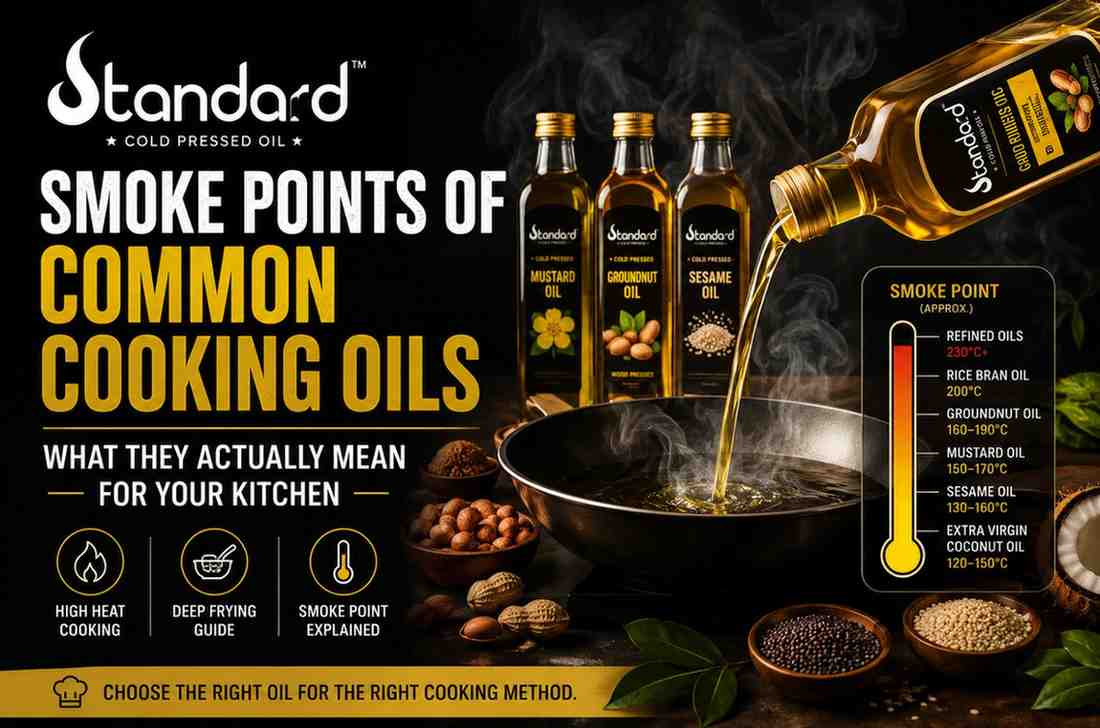
Smoke Point Figures for Common Cold Pressed Oils
The following approximate ranges are drawn from food science literature. Published values vary by study, seed quality, and extraction conditions. Treat these as reference ranges, not exact thresholds:
Cold Pressed Groundnut Oil: 160–180°C
Groundnut oil‘s fatty acid composition, approximately 46% oleic (monounsaturated), 32% linoleic (polyunsaturated), gives it relatively good heat stability among cold pressed options. Monounsaturated fats are more heat-stable than polyunsaturated, which is why olive oil (also predominantly oleic acid) has long been recommended for moderate-heat cooking. Cold pressed groundnut oil performs reliably for tempering, sauteing, making curry bases, shallow frying, and home deep frying at managed temperatures.
For Indian home cooking, where frying temperatures are typically 160–175°C and sessions last 10–20 minutes, cold pressed groundnut oil is within its operating range throughout.
Cold Pressed Mustard Oil: 150–180°C
Mustard oil‘s smoke point range reflects its composition: high in erucic acid and high in allyl isothiocyanate, both of which contribute to a somewhat lower smoke point but also to the oil’s characteristic flavour and stability profile. Traditional North Indian and Bengali cooking uses mustard oil at tempering temperatures (130–160°C for a tadka) and at frying temperatures (160–175°C for deep frying pakoras or fish). These applications fit comfortably within the oil’s smoke point range.
The traditional technique of heating mustard oil to just below smoking before adding ingredients, which appears counterintuitive from a smoke point perspective, actually serves a precise purpose: it volatilises and transforms the raw isothiocyanate compounds, converting the sharp raw pungency into a deeper, rounder flavour profile. Done with attention, the oil is brought close to but not past its smoke point.
Cold Pressed Sesame (Gingelly) Oil: 160–175°C
Cold pressed white sesame oil has an unusually good stability profile for a polyunsaturated-rich oil, because of its natural content of sesamol and sesamin, potent natural antioxidants present in sesame seeds that survive cold pressing and actively stabilise the oil’s polyunsaturated fatty acids during heating. This is why traditional South Indian cooking uses gingelly oil for extended deep frying of snacks like murukku and sev at temperatures around 160–170°C without the oil rapidly degrading.
Sesame’s natural antioxidant system is, in practical terms, a better guide to its cooking performance than its smoke point figure alone.
Cold Pressed Coconut Oil: 175–200°C
Virgin coconut oil has a higher smoke point than most assume. Its predominantly saturated fat composition (lauric acid, myristic acid, caprylic acid) makes it highly heat-stable. Saturated fats do not oxidise easily, their lack of double bonds means they are not vulnerable to the lipid peroxidation that affects polyunsaturated oils. Cold pressed virgin coconut oil handles most Indian cooking applications without issue.
For Comparison: Refined Oils
Refined groundnut oil: 220–230°C. Refined sunflower oil: 225–230°C. These higher figures exist because refining removes the compounds (free fatty acids, natural antioxidants, water) that cause smoke at lower temperatures. However, as the Grootveld research shows, a higher smoke point does not guarantee better cooking stability, refined sunflower oil with its high polyunsaturated content produces more harmful aldehydes at sustained frying temperatures than stable, lower-smoke-point alternatives.
What This Means for Your Everyday Cooking
For everyday Indian home cooking, cold pressed oils are within their performance range across virtually all applications. The relevant temperature thresholds:
- Tadka / tempering: 120–160°C, all cold pressed oils handle this easily
- Sauteing and curry base: 140–180°C, within range for all cold pressed oils mentioned
- Shallow frying: 160–180°C, cold pressed groundnut and sesame work well
- Home deep frying: 165–180°C, cold pressed groundnut oil recommended; keep consistent temperature, do not overheat
- Commercial sustained deep frying: 185°C+, refined oil’s higher smoke point provides a genuine advantage here
The concern about smoke point for home cooks is almost entirely about sustained commercial frying. For a home kitchen frying pakoras or fish two or three times a week, the smoke point of cold pressed groundnut or sesame oil is not a limiting factor.
One Practical Tip: Temperature Control Is More Important Than Oil Choice
The most important thing you can do to keep cooking oil, any cooking oil, performing well is to control your heat. Many smoke point violations in home cooking happen because the pan is preheated on high and the oil is added too late, or the heat is left on high throughout the cooking. Adding oil to a moderately heated pan, keeping temperature at medium to medium-high for most applications, and reducing to low for gentle simmering, this discipline extends the useful life of your oil regardless of type, and keeps you comfortably below smoke point thresholds across the board.
| Our cold pressed groundnut oil is our recommended everyday cooking oil for Indian kitchens, stable enough for the full range of home cooking, and genuinely different from refined versions in flavour and composition.standardcoldpressedoil.com/cold-pressed-groundnut-oil |
Related Reading
- Which Oil Is Best for Indian Cooking? A Practical, Region-by-Region Guide
- Cold Pressed vs Refined Oil: What Actually Changes in the Process
- Groundnut Oil for Deep Frying: What Makes It a Traditional Choice
