



Quick Answer
Millions of Indian families are returning to cold pressed kachi ghani oils after decades of refined oil use. The primary reason is flavour: food cooked in cold pressed mustard, groundnut, or sesame oil tastes the way it used to. A growing awareness of how refining works is the secondary driver.
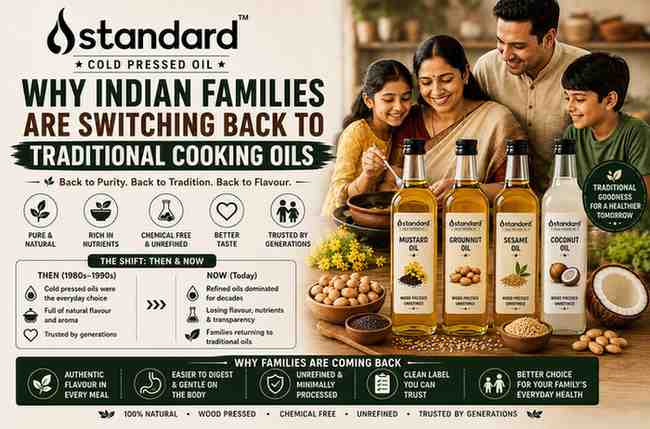
At a Glance
- Primary reason for switching: flavour, not health trends
- When it shifted: 1980s to 1990s, with widespread availability of cheap refined oil
- What was lost: flavour identity of regional Indian cooking
- What is returning: kachi ghani sarson tel, marachekku gingelly, wood-pressed moongfali tel
- Consumer trend: clean label movement, shorter ingredient lists, process transparency
Something has been shifting in Indian kitchens over the past decade.
It is not driven by imported wellness trends or advertising. It is quieter and more personal.
Families who switched to refined oil in the 1980s and 1990s are returning to kachi ghani mustard oil, cold pressed gingelly, and wood-pressed groundnut oil. Adult children ask their parents to teach them what they cooked with before the branded refined oil arrived. People who moved to cities from smaller towns describe missing the taste of food from home and tracing the difference directly to the oil.
What Happened in the 1980s and 1990s
The shift to refined oil in Indian households happened quickly, over one to two generations. Several factors converged.
- Refined oil was cheaper per litre: industrial extraction and solvent recovery increase yield per kilogram of seed
- The neutral flavour was marketed as modern and clean, positioning traditional oils as old-fashioned
- Larger packaging formats made refined oil more convenient
- Traditional ghani operators gradually disappeared from most urban markets
Within a generation, the flavour baseline of everyday cooking shifted. Children who grew up with refined sunflower oil did not have a comparison point for what the same dal tasted like in cold pressed groundnut oil. The reference disappeared.
The Flavour Argument: The Strongest One
Ask anyone who has returned to cold pressed oil why they switched, and the most common first answer is flavour.
Not health. Flavour.
Food cooked in cold pressed groundnut oil tastes different from the same food in refined sunflower. The difference is not subtle when you are paying attention.
- The depth in a curry base made in kachi ghani moongfali tel (groundnut oil)
- The way mustard seeds pop in cold pressed gingelly oil for a South Indian tadka
- The character of a fish fry when the sarson ka tel (mustard oil) has actual pungency
- The identity of a Kerala fish curry made in velichenna (cold pressed coconut oil)
These differences accumulate into food that tastes more like itself. The oil is doing something, not just transmitting heat.
What the Refining Process Actually Removed
The flavour loss from switching to refined oil was not incidental. It was the designed outcome.
Deodorising at 200 to 270 degrees Celsius removes every volatile compound that gives an oil its character. The pungency of sarson ka tel, the nuttiness of moongfali tel, the warmth of chekku ennai, the coconut identity of velichenna: all removed by design to produce a consistently neutral product.
When families describe food that tastes different from their childhood, they are describing the before and after of this process. The removal of flavour from cooking fat changed the food.
The Clean Label Movement in India
Indian urban consumers have shown increasing interest in clean label food products since approximately 2018.
FMCG research organisations tracking Indian consumer behaviour report growing percentages of households reading ingredient labels and specifically seeking shorter ingredient lists and questioning additives.
Cold pressed oil sits naturally in this movement:
- One ingredient in the bottle
- No TBHQ, BHA, BHT, or other synthetic additives
- A traceable, explainable process
- A shorter shelf life that signals nothing artificial is preserving it
For many families, buying cold pressed oil is one part of a broader shift: more whole foods, more cooking from scratch, more attention to what is in the food.
The Information Factor
A generation of Indian consumers has grown up with access to food information their parents did not have.
The specific knowledge that refined oil involves hexane extraction, bleaching with activated clay, deodorising at 250 degrees Celsius, and TBHQ addition to replace removed antioxidants, this information is now widely accessible. For many people, reading these steps for the first time produces a decision to find something simpler.
Cold pressed oil exists before any of those steps.
What the Transition Actually Looks Like
For families making this switch, the adjustment is usually easier than expected.
- Cold pressed groundnut oil (moongfali tel): easiest switch, minimal flavour adjustment, suits most Indian cooking
- Cold pressed sesame oil (gingelly / chekku ennai): suits South Indian cooking naturally, adjustment is recognising which dishes it elevates
- Cold pressed mustard oil (kachi ghani sarson tel): sharpest adjustment curve, biggest flavour payoff for the cooking traditions that use it
- Cold pressed coconut oil (velichenna / thengai ennai): natural fit for Kerala and coastal cooking, unfamiliar to non-coastal cooks
Families that switch and cook with cold pressed oil for a few months typically do not go back. The flavour difference is too noticeable.
| We carry the traditional oils that Indian cooking was built on, pressed the way they were always meant to be pressed. |
Related Reading
- What Is Cold Pressed Oil? A Simple Explanation [Blog 1]
- Kachi Ghani Oil: The Traditional Indian Method [Blog 4]
- How to Read an Edible Oil Label in India [Blog 7]
Frequently Asked Questions
Why did Indian families switch to refined oil in the first place?
Refined oil became widely available in the 1980s and 1990s at a lower price per litre, because industrial extraction with heat and chemical solvents yields significantly more oil per kilogram of seed. It was also marketed as modern and neutral-tasting. Over one to two generations, it replaced traditional oils in most urban kitchens.
What is kachi ghani sarson tel?
Kachi ghani sarson tel is cold pressed mustard oil extracted on a traditional wooden ghani press without heat or chemicals. It retains the full allyl isothiocyanate pungency of mustard seeds and is the traditional cooking fat of North and East Indian cuisine.
Does switching to cold pressed oil change the taste of food significantly?
Yes, noticeably. Food cooked in cold pressed groundnut, sesame, or mustard oil has more flavour depth than the same food cooked in refined neutral oil. The adjustment is most significant with mustard oil and least significant with groundnut oil, which has a mild, adaptable character.
Is cold pressed oil healthier than refined oil?
Cold pressed oil retains more of its natural composition including tocopherols, polyphenols, and natural flavour compounds that refining removes. Whether this translates into specific health benefits for a given individual depends on many factors. What is clear is that cold pressed oil is less processed and closer to the natural state of the seed.
What is moongfali tel?
Moongfali tel is the Hindi term for groundnut oil. Moongfali means peanut or groundnut. Kachi ghani moongfali tel specifically refers to cold pressed groundnut oil extracted on a traditional wood press.
