



Quick Answer
Cold pressed virgin coconut oil is white-to-pale-yellow, distinctly coconutty in aroma, and retains natural composition. Refined coconut oil is colourless and odourless after bleaching and deodorising. For South Indian and Kerala cooking, cold pressed is the correct choice. For neutral-fat applications, refined works but the coconut identity is absent.
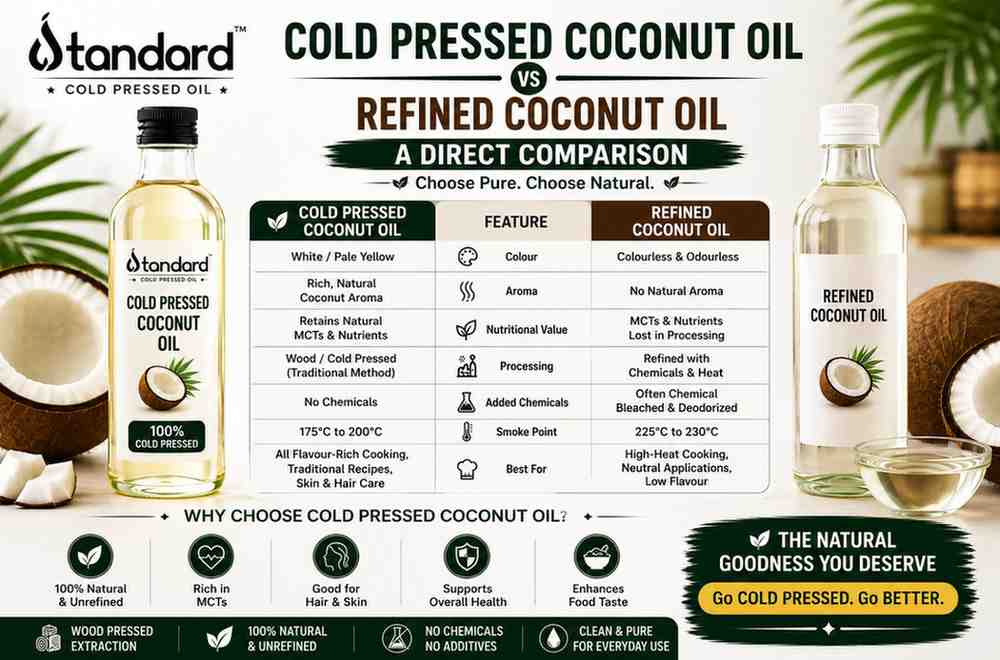
At a Glance
- Cold pressed: white/pale yellow, coconut aroma, smoke point 175 to 200°C
- Refined: colourless, odourless, smoke point 225 to 230°C
- Key difference: cold pressed retains lauric acid-rich MCT profile with natural antioxidants intact
- Kerala name: velichenna (cold pressed coconut oil)
- Tamil name: thengai ennai
- Best for cooking: cold pressed for all flavour-relevant applications
Two bottles, both labelled ‘coconut oil’. One is white and smells of coconut. The other is completely clear and odourless.
Both came from the same seed. The difference is entirely in what happened after pressing.
How Both Are Made: Step by Step
| Step | Cold Pressed Virgin Coconut Oil | Refined Coconut Oil |
|---|---|---|
| Raw material | Fresh or dried coconut flesh | Dried copra (dried coconut meat) |
| Pre-treatment | None or minimal | Often pre-heated to increase yield |
| Extraction | Cold press, below 49°C, no solvents | Expeller or solvent-assisted extraction |
| Bleaching | None | Activated clay removes colour |
| Deodorising | None | High-temperature steam, 200 to 270°C |
| Additives | None | Sometimes antioxidants added |
| Result | White/pale yellow, coconutty | Colourless, odourless, neutral |
Appearance and Sensory Differences
The differences are immediately obvious side by side.
- Colour: cold pressed is white when solid, pale yellow when liquid. Refined is completely clear.
- Smell: cold pressed has a strong, clean coconut aroma. Refined has no detectable smell.
- Taste: cold pressed contributes coconut flavour to food. Refined contributes nothing.
- Texture: both are identical in feel. The refining process does not change the oil’s physical feel.
Smoke Point Comparison
| Oil Type | Smoke Point | Suitable For |
|---|---|---|
| Cold pressed virgin coconut oil | 175 to 200°C | All everyday cooking, home frying, Kerala cuisine |
| Refined coconut oil | 225 to 230°C | Very high-heat applications, commercial frying |
| Cold pressed groundnut oil (for comparison) | 160 to 180°C | Everyday Indian cooking, home frying |
For home cooking, the smoke point difference between cold pressed and refined coconut oil rarely matters. Home cooking for Indian food sits below 180 degrees Celsius for most applications.
The higher smoke point of refined oil is relevant for sustained commercial frying operations, not a weekend avial or Kerala fish curry.
Lauric Acid and the MCT Composition
Both cold pressed and refined coconut oil contain similar fatty acid profiles because refining does not significantly alter the triglyceride structure.
Coconut oil is approximately 47 percent lauric acid, 18 percent myristic acid, 8 percent caprylic acid, and 7 percent capric acid. These are predominantly medium-chain triglycerides (MCTs).
The difference is in what surrounds those fatty acids. Cold pressed oil retains natural antioxidants and phytosterols. Refined oil removes them. This does not affect the MCT content but it does affect the overall composition of what you are cooking with.
Which to Use for Which Application
| Application | Best Choice | Why |
|---|---|---|
| Kerala cooking (avial, thoran, fish curry) | Cold pressed | Coconut flavour is part of the dish |
| Tamil Nadu coastal cooking | Cold pressed | Thengai ennai’s aroma is the traditional base |
| Payasam and sweet preparations | Cold pressed | Coconut aroma enhances the dish |
| Neutral-fat baking (no coconut flavour wanted) | Refined | Odourless, does not affect baked goods flavour |
| Everyday North Indian cooking | Cold pressed groundnut instead | Coconut flavour out of place in most North Indian dishes |
| Daily oil massage (Abhyanga) | Cold pressed | Traditional practice uses food-grade cold pressed |
Identifying Real Cold Pressed Coconut Oil
- Colour: white when solid, pale yellow when fully liquid. Not clear.
- Smell: clearly coconutty when you open it. Not odourless.
- Solidification: solid below 24 degrees Celsius, liquid above. Both states are normal.
- Ingredients: coconut oil only. No additives.
- Shelf life: 18 to 24 months unopened for genuinely unrefined oil.
- Label terms: ‘virgin’, ‘cold pressed’, or ‘extra virgin’ indicate minimal processing. ‘RBD’ (refined, bleached, deodorised) means the refined version.
| Our coconut oil is cold pressed from fresh coconut without bleaching or deodorising. White, aromatic, and genuinely traditional. |
Related Reading
- Coconut Oil for Cooking: Separating Facts from the Noise [Blog 11]
- Which Oil Is Best for Indian Cooking? [Blog 6]
- How to Read an Edible Oil Label in India [Blog 7]
Frequently Asked Questions
What is the difference between virgin coconut oil and refined coconut oil?
Virgin (cold pressed) coconut oil is extracted at low temperatures without solvents, retaining its natural coconut aroma and white-to-pale-yellow colour. Refined coconut oil (also labelled RBD) is bleached and deodorised, removing all colour and aroma. The fatty acid profile is similar, but the sensory experience and retained natural compounds differ significantly.
What does RBD coconut oil mean?
RBD stands for Refined, Bleached, and Deodorised. It describes the three processing stages that turn crude coconut oil into the colourless, odourless refined product. RBD coconut oil has a higher smoke point and longer shelf life but lacks the natural coconut aroma of virgin cold pressed oil.
Is cold pressed coconut oil better than refined for cooking?
For cooking where coconut flavour is desirable or neutral, yes. For Kerala cuisine, South Indian coastal cooking, and coconut-based preparations, cold pressed is the appropriate choice. For applications specifically requiring a neutral-flavoured fat, refined coconut oil or a different oil entirely may be more suitable.
What is velichenna?
Velichenna is the Malayalam term for coconut oil, used primarily in Kerala. It refers to cold pressed coconut oil in its traditional form: white, aromatic, extracted without chemicals. It is the cooking fat that Kerala cuisine was built around.
Does cold pressed coconut oil have a higher smoke point than olive oil?
Yes. Cold pressed virgin coconut oil has a smoke point of 175 to 200 degrees Celsius. Extra virgin olive oil has a smoke point of approximately 160 to 190 degrees Celsius depending on quality. Both are adequate for everyday cooking, and both are higher than many people assume for unrefined oils.
Can I use cold pressed coconut oil for deep frying?
For home frying at 160 to 175 degrees Celsius, yes. Its high saturated fat content makes it heat-stable and less prone to producing harmful oxidation compounds than high-polyunsaturated oils at the same temperatures. For sustained commercial frying at 185 degrees Celsius and above, refined coconut oil or groundnut oil is more appropriate.
