



If you have seen the words ‘cold pressed‘ on an oil bottle and moved on without reading further, you are not alone. The term sounds like a health buzzword. It sits next to ‘organic’, ‘natural’, and ‘pure’ on packaging, and after a while, all those words start to blur together.
But cold pressing actually describes something specific and verifiable. It describes how the oil was extracted from the seed. And that process, what happens between a raw peanut or sesame seed and the oil that reaches your kitchen, changes the finished product more than most of us realise.
Let us walk through this properly, from the seed all the way to your pan.
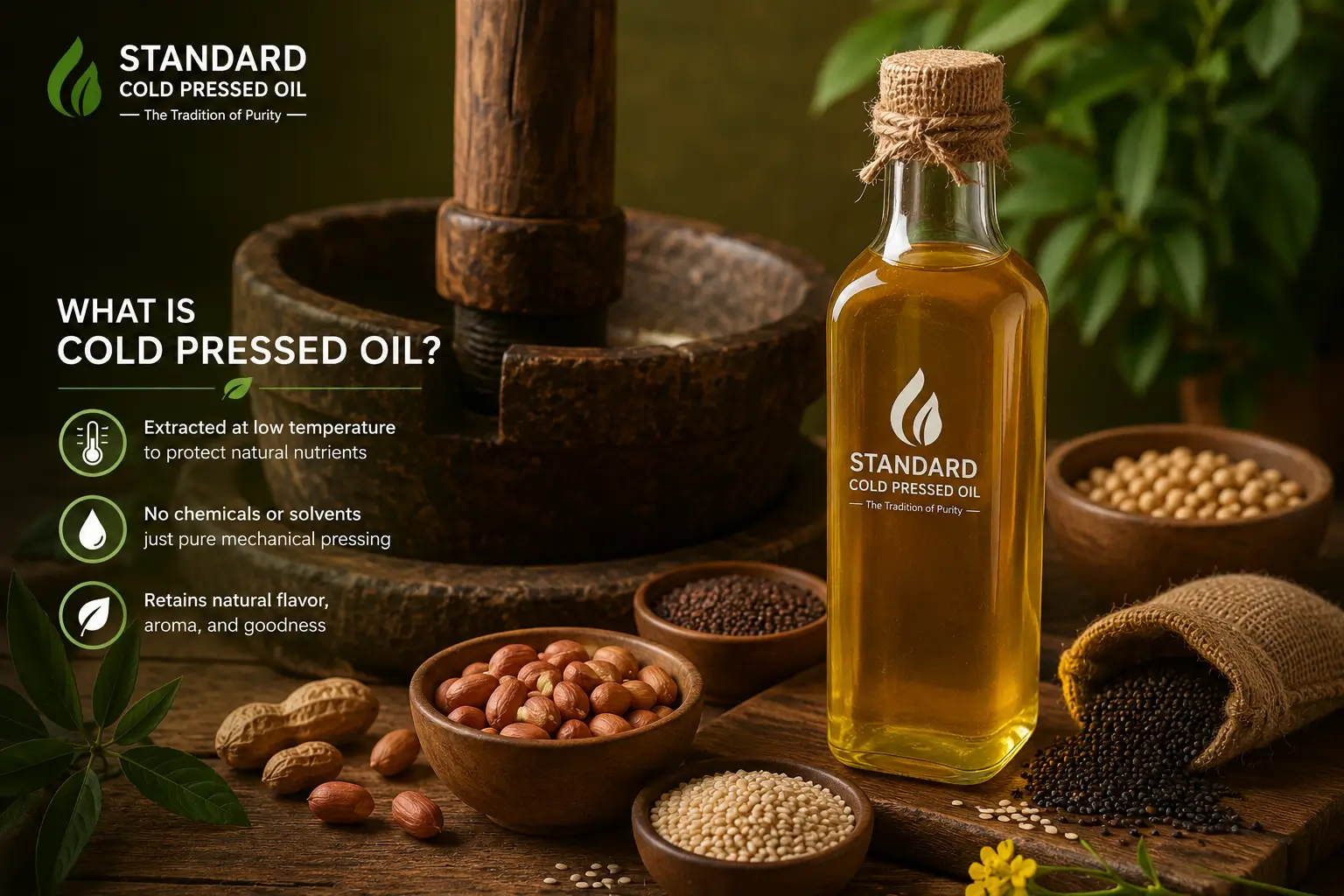
Every Oil Starts as a Seed. What Happens Next Is the Whole Story.
Groundnuts, sesame seeds, coconuts, mustard seeds, all of these contain oil locked within their cellular structure. To release that oil, you need mechanical pressure. The question is what else you are willing to add to that process: heat, chemical solvents, bleaching agents, deodorisers.
Cold pressing is the answer that says: nothing else. Just pressure.
In a cold press, or in the traditional Indian equivalent, the kachi ghani wooden press, seeds are fed into a slowly rotating press. The wooden or metal parts move deliberately slowly. At that pace, friction stays low.
The temperature stays low. Most published estimates for well-run cold presses put operating temperatures below 45–49°C. Compare that to industrial hot-press extraction, where seed masses routinely reach 60°C or above before chemical solvents are applied to extract remaining oil from the residue.
At below 49°C, the natural compounds in the oil, tocopherols (a family of Vitamin E compounds), polyphenols, carotenoids, phospholipids, and the volatile aromatic molecules that give each oil its characteristic smell, remain structurally intact. They travel with the fatty acids into the bottle.
At higher temperatures, these compounds begin to break down at different rates. Volatile aroma molecules evaporate first. Heat-sensitive antioxidants degrade. Certain polyunsaturated fatty acids begin to oxidise. This is not hypothetical, it is basic lipid chemistry, and it is why industrially refined oils smell and look so different from what came out of the seed.
The Colour in the Bottle Tells You Something Real
Open a bottle of our cold pressed groundnut oil for the first time and you will notice the colour, a deep, warm gold, almost amber in good light. Standard refined groundnut oil is pale, nearly water-white. The difference is not cosmetic.
The golden colour in cold pressed groundnut oil comes from carotenoids and other natural pigments present in the peanut. In refined oil, these are removed during the bleaching step, a process where activated clay or charcoal is used specifically to strip colour from the crude oil. The natural pigments are removed not because they are harmful, but because a consistent, pale appearance is easier to market to a broad audience.
The same logic applies to the smell. Cold pressed sesame oil has a warm, toasty, nutty aroma that immediately identifies what it is. Cold pressed mustard oil is sharp and pungent. Cold pressed coconut oil smells unmistakably of coconut.
These are the real smells of these seeds. Refined versions of the same oils are deodorised, steam-treated at temperatures between 200 and 270°C, to remove all detectable aroma. What comes out is odourless and flavourless by design.
For cooking in Indian kitchens, where flavour complexity is valued and where specific regional dishes are built around the character of particular oils, that deodorisation removes something genuinely meaningful.
What ‘Chemical-Free’ Actually Means
When we say our oils are chemical-free, we mean specifically that no chemical solvents are used in extraction. In standard commercial oil production, the mechanical press extracts roughly 60–70% of the oil from the seed.
The remaining oil in the seed cake is recovered using hexane, a petroleum-derived solvent that dissolves the oil out of the pressed residue. The hexane is then evaporated off, and the oil undergoes further refining.
FSSAI sets maximum residue limits for hexane in edible oil, and commercially refined oils in India comply with these limits. The amounts are considered safe. But the point is that the process involves a petroleum-derived chemical that never comes anywhere near a cold-pressed oil.
Cold pressing extracts the available oil through pressure alone, leaves the seed cake with its remaining oil content behind, and stops there. No solvents. No bleaching. No deodorising. No antioxidant additives to replace what processing destroys.
Why Does Cold Pressed Oil Cost More?
This is a fair question, and the answer is not mystical. Cold pressing yields less oil per kilogram of raw seed than hot pressing combined with solvent extraction. A kilogram of raw groundnuts run through cold pressing yields roughly 350–400 ml of oil.
The same kilogram through industrial hot-pressing and solvent extraction can yield 450–500 ml or more. That additional yield is the economic basis of mass-market refined oil.
Cold pressed oil, because it leaves more oil behind in the seed cake and charges no cost for solvents or complex refinery equipment, operates at a different cost structure. You pay more per litre, and in return you get oil that is closer to what came out of the seed.
Shelf Life: The Honest Trade-Off
Refined oil lasts longer on the shelf. This is true and worth knowing. The natural compounds that make cold pressed oil more complex, particularly the unsaturated fatty acids and the natural antioxidants that accompany them, also oxidise over time.
Refined oil, stripped of these compounds and often fortified with synthetic antioxidants like TBHQ, can sit in a bottle for 18–24 months.
Cold pressed oil, unopened, typically stays good for 9–12 months from manufacture. Once opened, you want to use it within 3–4 months. Store it away from heat and direct light, ideally in a dark cupboard or even the refrigerator for sesame and mustard.
For most households that use oil regularly, this timeline is entirely manageable. The key is buying appropriate quantities rather than stockpiling.
How Cold Pressed Oil Fits Into Real Everyday Cooking
Cold pressed oil is kitchen oil. Not a supplement. Not a wellness product. Oil you cook in.
Our cold pressed groundnut oil works for tempering whole spices in a kadai, making a curry base from scratch, shallow-frying fish or vegetables, and even for occasional deep frying at managed temperatures. The flavour is mild enough that it does not dominate dishes the way mustard oil might. It handles a broad range of Indian cooking comfortably.
If you are switching from refined oil to cold pressed for the first time, groundnut oil is the most straightforward transition. The flavour adjustment is minimal. The cooking method stays the same. The main change is that your food will smell more like real peanuts, which, once you are used to it, feels like the oil is actually doing something.
| We press our groundnut oil in the traditional kachi ghani way, wood-pressed, unrefined, and chemical-free. If you want to see what cold pressing actually produces, this is a good place to start.standardcoldpressedoil.com/cold-pressed-groundnut-oil |
Related Reading
- Cold Pressed vs Refined Oil: What Actually Changes in the Process
- Wood Pressed Oil vs Machine Pressed Oil: Is There a Real Difference?
- How to Read an Edible Oil Label in India: What the Terms Mean
