



Quick Answer
Cold pressed mustard oil is a pungent, amber-coloured cooking fat used across North and East Indian cuisine. Its sharpness comes from allyl isothiocyanate, a compound preserved only in cold pressed extraction. It works for tempering, frying, raw marinades, and traditional Indian pickles.
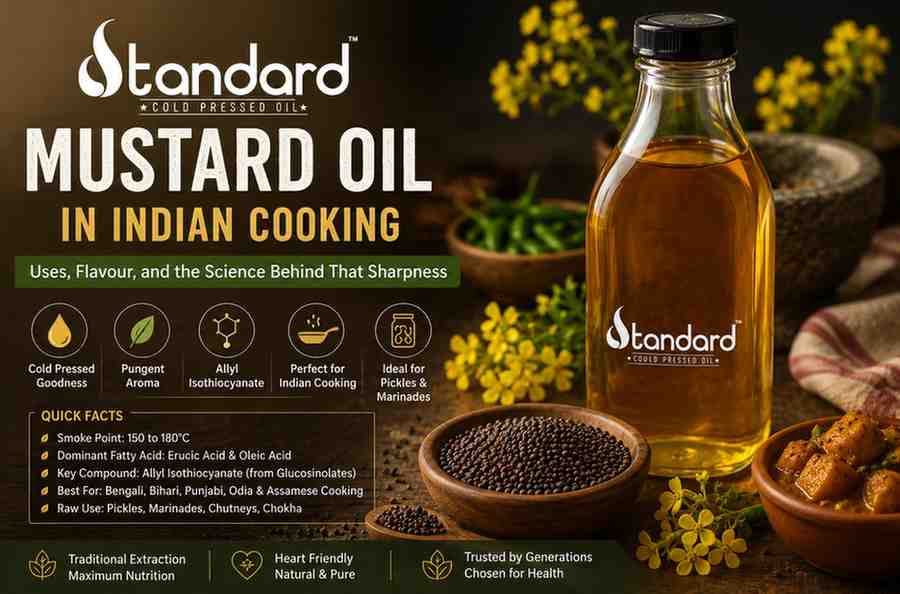
Experience the Purity of Cold Pressed Mustard Oil
Enjoy the authentic taste of traditional Indian cooking with our 100% Cold Pressed Kachi Ghani Mustard Oil. Naturally extracted using traditional methods to preserve its rich aroma, essential nutrients, and bold flavour.
At a Glance
- Smoke point: 150 to 180 degrees Celsius
- Dominant fatty acid: erucic acid and oleic acid
- Key flavour compound: allyl isothiocyanate (from glucosinolates)
- Traditional names: kachi ghani tel, sarson ka tel, shorshe tel
- Best for: Bengali, Bihari, Punjabi, Odia, and Assamese cooking
- Raw use: pickles, marinades, chutneys, chokha
There is a moment in a Bengali kitchen when mustard oil hits a hot pan.
The oil sizzles, darkens slightly, and releases a sharp smell that fills the room. To a Bengali cook, that means the food is actually starting. To someone unfamiliar, it can seem overpowering.
Mustard oil polarises people. North and East Indians who grew up with it treat anything else as a compromise. Those new to it find the flavour startling at first. Both reactions make complete sense, because mustard oil is not a neutral cooking medium. It is an ingredient with a regional identity.
Why Mustard Oil Is So Pungent: The Chemistry
Mustard seeds contain compounds called glucosinolates.
When seeds are crushed, an enzyme called myrosinase activates and converts glucosinolates into allyl isothiocyanate, the compound responsible for mustard oil’s sharp, nose-clearing character.
This conversion happens precisely because cold pressing keeps temperatures low enough for myrosinase to remain active. At high processing temperatures, myrosinase denatures and the conversion does not occur fully. This is why refined mustard oil is comparatively mild.
| If your mustard oil does not smell sharp when you open it, it was likely refined or processed at temperatures too high for genuine cold pressing. |
The Pakao Technique: Why You Heat It to Smoke
In Bengal, Bihar, and Odisha, mustard oil is traditionally heated to just below its smoke point before adding any ingredients.
Bengali cooks call this pakao. In Hindi-speaking kitchens, it is simply ‘tel garam karna with temperature’.
At around 150 to 160 degrees Celsius, allyl isothiocyanate begins to volatilise and convert into less aggressive forms. The raw sharpness becomes a deeper, rounder, more savoury note.
This is not a workaround for a fault in the oil. It is a deliberate culinary technique that shapes the oil’s character for the dish.
Raw Applications: When You Want the Full Punch
Some preparations require raw cold pressed mustard oil specifically because the heat-modified version delivers a different flavour.
- Pickles: North Indian mixed vegetable achar, Bihari oil-based pickles, Bengali achar. Raw mustard oil acts as both flavour agent and preservation medium.
- Marinades: Fish rubbed with mustard oil before grilling or frying. The raw pungency penetrates the flesh differently from any cooked oil.
- Litti chokha: The chokha (roasted mashed vegetable) is finished with raw mustard oil and green chillies. The raw oil is the defining flavour note.
- Chutneys: Some Bengali and Odia preparations use a small raw drizzle as a finishing touch.
Regional Uses Across India
Bengal (Shorshe Tel)
Machher jhol, shorshe ilish, chingri malai curry, aloo posto. Virtually all Bengali cooking uses mustard oil as the primary fat, heated to smoke for most preparations, used raw in others.
Replacing mustard oil in these dishes with a neutral oil changes them at a fundamental level.
Bihar and Jharkhand
Litti chokha is the most iconic example. Sattu preparations, vegetable curries, and fish dishes in Bihar lean on mustard oil’s distinct character.
Punjab and Haryana
Sarson da saag made with sarson ka tel. The pairing is intuitive: mustard leaves cooked in mustard oil. Makki roti, winter cooking, and achars all rely on mustard oil.
Odisha and Assam
Fish tenga (sour fish curry) in Assam uses mustard oil throughout. Odia pithas and fish preparations use kachi ghani sarson tel as the primary fat.
Mustard Oil Compared to Other Indian Cooking Oils
| Property | Cold Pressed Mustard | Cold Pressed Groundnut | Refined Sunflower |
|---|---|---|---|
| Smoke Point | 150 to 180°C | 160 to 180°C | 225 to 230°C |
| Flavour | Sharp, pungent | Mild, nutty | Neutral, none |
| Key Use | Bengali, Bihari, Punjabi cooking | South Indian, everyday cooking | Generic frying |
| Traditional | Yes, kachi ghani | Yes, wood pressed | No |
| Best For | Tadka, pickling, raw marinades | Tadka, frying, curry bases | High-heat commercial frying |
The Erucic Acid Question
Cold pressed mustard oil contains erucic acid, a monounsaturated fatty acid that generates questions.
The concern in Western nutrition research comes from animal studies at very high doses. In India, mustard oil has been a dietary staple for centuries. FSSAI permits mustard oil for edible use without restriction.
The US and EU have stricter limits because their populations historically did not consume mustard oil. FSSAI regulates it as a normal edible oil. If you are cooking with it the way Indian kitchens traditionally have, this is useful context to have.
How to Identify Genuine Kachi Ghani Mustard Oil
- Colour: deep amber to dark yellow, not pale
- Smell: assertive and clearly mustard-like when you open the bottle
- Taste raw: distinct bite that fades after heating
- Best-before date: 12 to 18 months from manufacture
- Ingredients list: mustard oil only, no additives
| Our kachi ghani mustard oil carries the full allyl isothiocyanate character that North and East Indian cooking requires. |
Related Reading
- Kachi Ghani Oil: The Traditional Indian Method Still Worth Using [Blog 4]
- Which Oil Is Best for Indian Cooking? [Blog 6]
- How to Store Cold Pressed Oils So They Last Longer [Blog 13]
Frequently Asked Questions
Why is cold pressed mustard oil more pungent than the refined version?
Cold pressing preserves the myrosinase enzyme in mustard seeds, which converts glucosinolates into allyl isothiocyanate, the compound responsible for mustard oil’s sharpness. High-temperature refining destroys this enzyme, so refined mustard oil produces significantly less allyl isothiocyanate.
Is it safe to use cold pressed mustard oil for deep frying?
Yes, for home frying sessions. Cold pressed mustard oil has a smoke point of 150 to 180 degrees Celsius, which is adequate for pakoras, fish fry, and similar preparations at home frying temperatures of 160 to 175 degrees Celsius.
What does it mean to ‘heat mustard oil to smoke’?
This is the traditional pakao technique used in Bengali, Bihari, and Punjabi cooking. Heating the oil close to its smoke point volatilises the harsh raw isothiocyanate compounds, converting the sharpness into a deeper, more rounded cooking flavour.
Can I use cold pressed mustard oil for salad dressings?
Yes. Raw mustard oil in small quantities works well in South Asian-style dressings, chutneys, and marination. The pungency is strong, so start with less than you think you need and adjust from there.
What is kachi ghani mustard oil?
Kachi ghani refers to traditional wood-press extraction at low temperatures. In the context of mustard oil, kachi ghani tel is cold pressed mustard oil extracted without heat, retaining the full glucosinolate-derived pungency of the seed.
Is mustard oil the same as sarson oil?
Yes. Sarson is the Hindi word for mustard. Sarson ka tel, shorshe tel (Bengali), kaduku ennai (Tamil), and avalu nune (Telugu) all refer to mustard oil, though regional varieties and processing methods can produce slightly different flavour profiles.
