



Quick Answer
Cold pressed sesame oil (gingelly oil) has been used in Ayurvedic hair and skin care for centuries. It contains oleic acid, linoleic acid, and sesamol, all compatible with skin’s natural lipid structure. The Charaka Samhita describes it as the best oil for external application. Food-grade cold pressed gingelly oil is the traditional version for topical use.
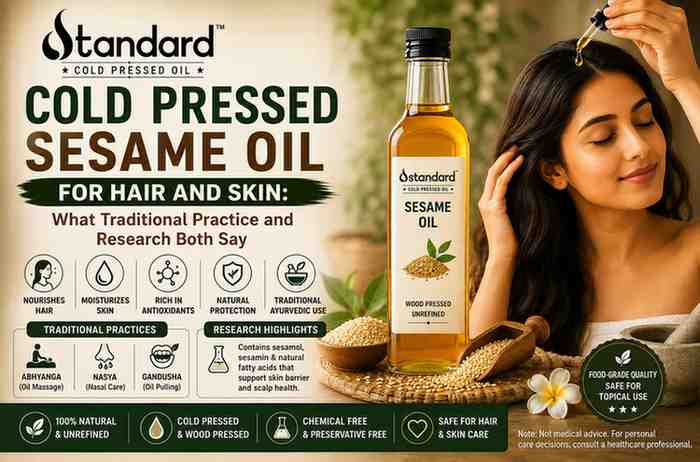
At a Glance
- Key compound: sesamol, sesamin, sesamolin (natural antioxidants)
- Fatty acids for skin: 39% oleic acid, 41% linoleic acid
- Traditional Ayurvedic uses: Abhyanga (oil massage), Nasya, Gandusha (oil pulling)
- Traditional practice: same food-grade cold pressed gingelly oil for cooking and body care
- Note: not medical advice. For personal care decisions, consult a healthcare professional.
Sesame oil appearing in a section about hair and skin care on a cooking oil brand’s blog is not a category error.
In South Indian households, the bottle of cold pressed gingelly oil on the kitchen shelf genuinely serves both purposes. The practice of using food-grade cold pressed sesame oil for topical applications is centuries old, documented in Ayurvedic texts, and still maintained in many traditional families.
This blog covers what that tradition involved and what published research says about the properties relevant to topical use. It is not medical advice, and we are not claiming this oil treats any condition.
What Ayurvedic Tradition Says
In Ayurveda, sesame oil holds a specific place among therapeutic oils.
The classical Charaka Samhita describes tila taila (sesame oil) as the best among oils for external application, noting its penetrating quality and warming nature.
Three major Ayurvedic practices traditionally use sesame oil as the default medium:
- Abhyanga: warm oil self-massage performed as part of the daily dinacharya (daily routine)
- Nasya: nasal oil application
- Gandusha: oil pulling, swishing oil around the mouth
These practices are documented in texts several thousand years old. Whatever one thinks of Ayurvedic constitutional frameworks, the practical observation that sesame oil absorbs well and feels compatible with skin is consistently reported across traditions.
The Composition That Makes It Relevant Topically
| Component | Amount | Topical Relevance |
|---|---|---|
| Oleic acid | ~39% | Present in skin’s natural lipid barrier, absorbs well |
| Linoleic acid | ~41% | Skin-compatible fatty acid, supports barrier function research |
| Sesamol | Present | Natural antioxidant, studied in multiple research contexts |
| Sesamin | Present | Natural lignan antioxidant, contributes oxidative stability |
Both oleic and linoleic acid are naturally present in human skin’s lipid barrier. Oils with a composition similar to skin’s own lipids tend to absorb well and integrate compatibly with the skin surface.
Hair Application: The Traditional Practice
Warm sesame oil applied to the scalp and massaged through the hair is a practice maintained across South India, particularly in Tamil Nadu, Andhra Pradesh, and Kerala.
The traditional method involves warming the oil gently (not to cooking temperature) and massaging into the scalp, working through to the ends, and leaving for at least an hour or overnight before washing.
A 2011 study published in the Journal of Ethnopharmacology examined sesame oil among traditional oils used for hair care in India, noting its historical and cultural prevalence. Studies on oil treatment and hair tensile strength have included sesame oil, with findings suggesting oil application generally reduces combing force and breakage across multiple oil types.
Skin Application: Published Research
A review published in the International Journal of Molecular Sciences (2021) examined sesame oil’s dermatological applications.
The review covers sesame oil’s favourable fatty acid profile, antioxidant content, and Ayurvedic historical use. It acknowledges that clinical trials specifically examining sesame oil for defined skin conditions remain limited.
In neonatal care, sesame oil has been used in South Asian practice for infant massage. Research on this practice has generally found it safe and well-tolerated
Food-Grade vs Cosmetically Marketed Sesame Oil
Cold pressed food-grade gingelly oil is the historically appropriate version for topical use.
The traditional practice did not use industrially refined or specially formulated cosmetic products. It used the same oil that went into the cooking pot.
- Cold pressed gingelly oil: retains sesamol, sesamin, and natural fatty acid profile
- Refined sesame oil: removes sesamol and sesamin along with colour and aroma
- Cosmetically marketed sesame oil: often refined with fragrance added back
For topical applications following traditional practice, food-grade cold pressed gingelly oil is the consistent choice. There is no added benefit to cosmetic formulations over the original.
| Our food-grade cold pressed sesame oil is suitable for both cooking and traditional topical use. Same oil, two applications. |
Related Reading
- Sesame Oil in Indian Cooking: Gingelly, Til, Chekku Ennai [Blog 10]
- Using Coconut Oil on Hair and Skin [Month 2, Blog 10]
- What Is Cold Pressed Oil? A Simple Explanation [Blog 1]
Frequently Asked Questions
Can I use cold pressed gingelly oil directly on my hair?
Yes, this is the traditional practice. Warm the oil gently without heating it to cooking temperature. Massage into the scalp and through the hair, leave for at least an hour or overnight, then wash out. Food-grade cold pressed gingelly oil is the historically appropriate version for this use.
Is sesame oil good for dry skin?
Sesame oil contains oleic acid and linoleic acid, both found naturally in the skin’s lipid barrier, which makes it compatible for topical use. It has been used in Ayurvedic practice for skin application for centuries. For specific skin conditions, consulting a dermatologist is advisable.
What is Abhyanga?
Abhyanga is the Ayurvedic practice of warm oil self-massage, traditionally performed as part of the daily routine (dinacharya). Sesame oil is the default medium recommended in classical texts including the Charaka Samhita, described as the best oil for external application.
Should I use food-grade or cosmetic sesame oil for hair?
Food-grade cold pressed gingelly oil is the traditional choice and retains sesamol and sesamin that refining removes. Many cosmetically marketed sesame oils are refined with fragrance added back. The food-grade cold pressed version is the more natural and historically consistent option.
Does cold pressed sesame oil block pores?
Sesame oil has a relatively low comedogenic rating, meaning it is not strongly associated with clogging pores. Its oleic and linoleic acid composition is similar to the skin’s natural lipids. Individual responses vary, and patch testing before full application is sensible.
