



In the late 19th century, the British colonial administration in India commissioned surveys of local oil production practices. What those surveys documented was a technology already thousands of years old: the ghani, a stone or wooden mortar driven by animal power, pressing oil from seeds with quiet, unhurried efficiency in every village across the subcontinent.
The kachi ghani was not an invention. It was an accumulation. Refined over centuries by people who ate what they pressed, who had strong incentive to get it right, and who passed the knowledge of the right seed quality, right pressing speed, and right seasonal adjustments down through families and communities.
That method is what we use. And there are very specific reasons why it still produces oil that modern machinery struggles to replicate exactly.
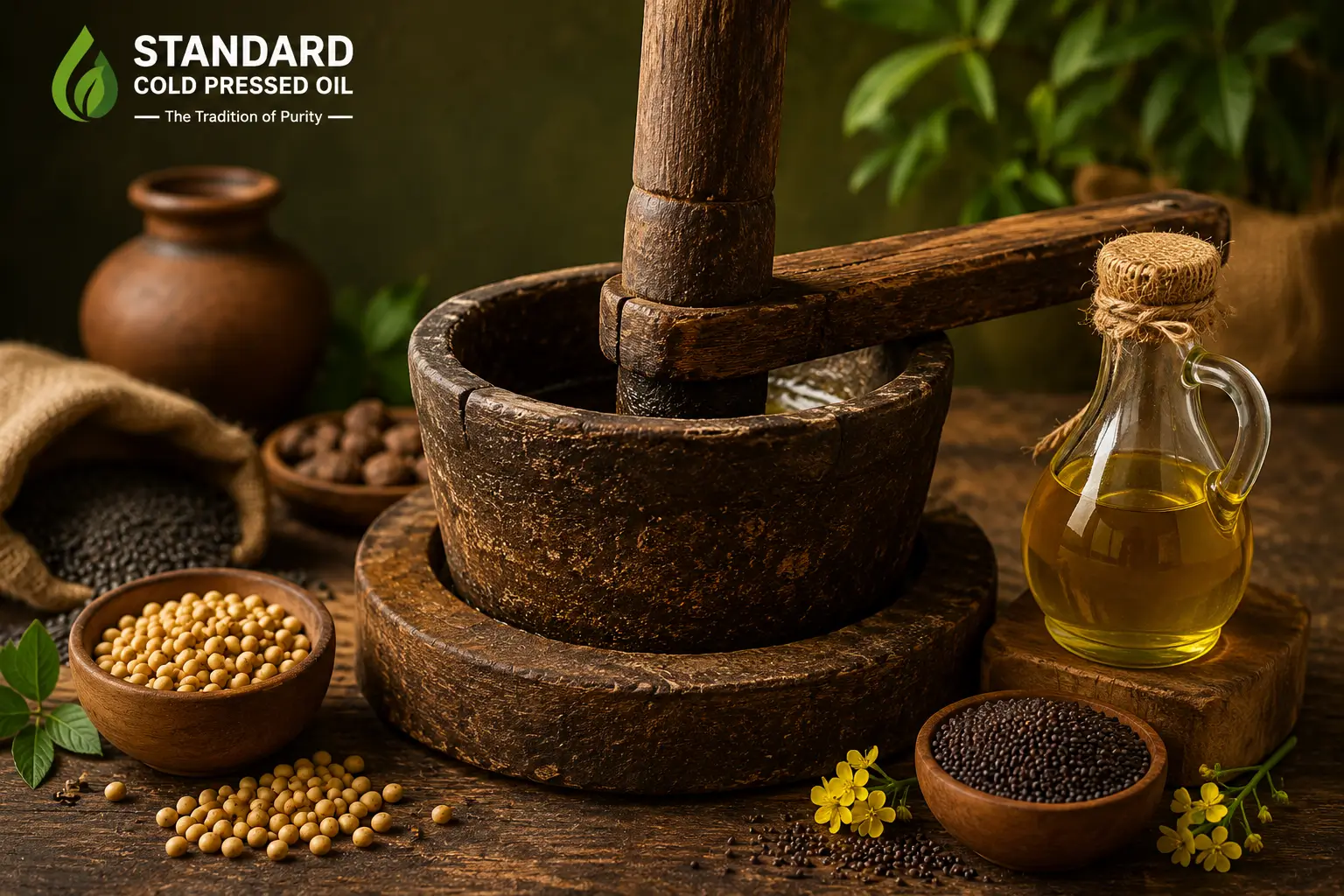
The Physics of Kachi Ghani Pressing
The kachi ghani works through a combination of shear force and compression. The wooden shaft rotates inside the mortar, and as seeds are fed in, they are caught between the shaft and the mortar wall. The grinding action crushes the cell walls of the seed, releasing oil from within the oil bodies (spherosomes) in the seed’s cotyledon.
The critical variable is rotational speed. Traditional bullocks walk at approximately 2–3 km/h. The radius of a standard ghani converts this to a shaft rotation of roughly 6–8 RPM. At 6–8 RPM, the mechanical energy going into crushing the seed translates almost entirely into oil extraction rather than heat generation. Thermal imaging of active kachi ghani operations documented in Indian food science research from the 1990s and 2000s typically shows extraction temperatures in the 35–45°C range, well within the zone where all major oil-soluble compounds remain stable.
Motor-driven kachi ghani presses, the version most artisanal cold pressed producers use today, attempt to maintain the same low RPM profile. Good operators monitor the temperature of the oil as it flows out and adjust speed if it climbs. The wooden construction also helps: wood has low thermal conductivity compared to metal, which means less heat transfers from the mechanical components into the oil.
Why the Wood Matters Beyond Tradition
There is a practical reason why kachi ghani presses are made of wood rather than metal, and it is not just because metal was less available in ancient India. Wood has a thermal conductivity of roughly 0.1–0.4 W/m·K depending on the species used. Steel has a thermal conductivity of roughly 50 W/m·K. This difference means that frictional heat generated during pressing stays localised in the contact zone rather than spreading through the press structure and back into the oil.
In a metal press, heat generated in the crushing zone spreads through the steel shaft and barrel and can warm the oil batch as a whole. In a wooden press, the heat stays where it is generated and dissipates more slowly: which at low RPM means it barely builds up at all.
This is one reason why, even when steel machine presses are operated at carefully controlled temperatures, the oil may still show slightly different sensory characteristics from wood-pressed oil. The thermal environment at the micro-scale of the pressing contact point differs.
Regional Names, Same Method
The kachi ghani is not a North Indian invention. Every major oil-producing region of India developed its own version:
- Ghani / Kachi Ghani, North India, particularly Rajasthan, Punjab, Uttar Pradesh, Bihar
- Chekku, Tamil Nadu and parts of Andhra Pradesh; traditionally stone-based
- Ganuga, Andhra Pradesh and Telangana (ganuga nune = groundnut oil pressed on a ganuga)
- Kolhu, widespread across Hindi-speaking states
- Marachekku, Tamil Nadu (mara = wood, chekku = press)
These are all variants of the same technology principle. The differences are in the material (stone vs wood), the exact geometry of the mortar, and the seed types traditionally pressed in each region. The shared characteristic is slow, cool, chemical-free extraction.
When you see ‘chekku ennai’ or ‘ganuga nune’ on a product, you are looking at a claim of regional kachi ghani-equivalent pressing. The flavour profile of a good chekku-pressed gingelly oil from Tamil Nadu and a good kachi ghani-pressed sesame oil from Rajasthan may differ slightly, different seed varieties, different pressing geometry, but both are genuine expressions of the traditional method.
What Industrialisation Changed, and What It Could Not Take
When industrial oil extraction arrived in India in the mid-20th century, the kachi ghani nearly disappeared from commercial use. Hydraulic presses and then continuous screw expellers could process in an hour what a kachi ghani processed in a day. The economic logic was overwhelming.
But something interesting happened in the households and communities that maintained access to kachi ghani oil, through local presses, through cooperative ghani operators, through small-scale artisanal producers. Food that was cooked in kachi ghani oil retained a flavour profile that families recognised and preferred. The sarson da saag made with real kachi ghani mustard oil tasted different from the version made with refined mustard oil. The machher jhol, the aloo posto, the Andhra gongura pickle, all of these dishes carry the specific character of the oil they are made in.
Industrial oil extraction could scale production. What it could not do was replicate that flavour character, because flavour character comes from the precise volatile compounds and natural lipid structures that slow, cool pressing preserves and fast, hot pressing destroys.
Kachi Ghani Mustard Oil: The Most Dramatic Example
If you want to understand the difference between kachi ghani and refined oil in the most direct sensory way possible, try mustard oil. Open a bottle of refined mustard oil, the kind widely available in supermarkets, and note the colour (pale yellow) and the smell (mild, barely present). Then open a bottle of genuine kachi ghani mustard oil. The colour is noticeably deeper, moving toward amber. The smell hits immediately: sharp, pungent, the classic sinus-clearing character that North Indian and Bengali cooks expect from their cooking oil.
That sharpness is allyl isothiocyanate, formed when glucosinolates in mustard seeds are enzymatically broken down during pressing. At low temperatures, the enzyme myrosinase remains active during pressing and drives this conversion. At high temperatures, myrosinase denatures and less allyl isothiocyanate is produced: which is part of why industrially processed mustard oil loses its characteristic pungency.
This is exactly what our cold pressed mustard oil preserves. The pungency is not a defect. It is the oil doing what mustard oil is supposed to do.
Related Reading
- Wood Pressed Oil vs Machine Pressed Oil: Is There a Real Difference?
- Mustard Oil in Indian Cooking: Uses, Flavour, and What to Know
- Which Oil Is Best for Indian Cooking? A Practical Guide
