



Quick Answer
Nattu sakkarai, also called country sugar or palm jaggery, is made by slowly boiling down palm or sugarcane juice without removing the molasses, so it retains trace minerals and a deeper flavour that refined white sugar loses in processing. Both are still sugar and both affect blood sugar levels, the difference is in what stays in the crystal, not in whether it counts as sugar in your diet.
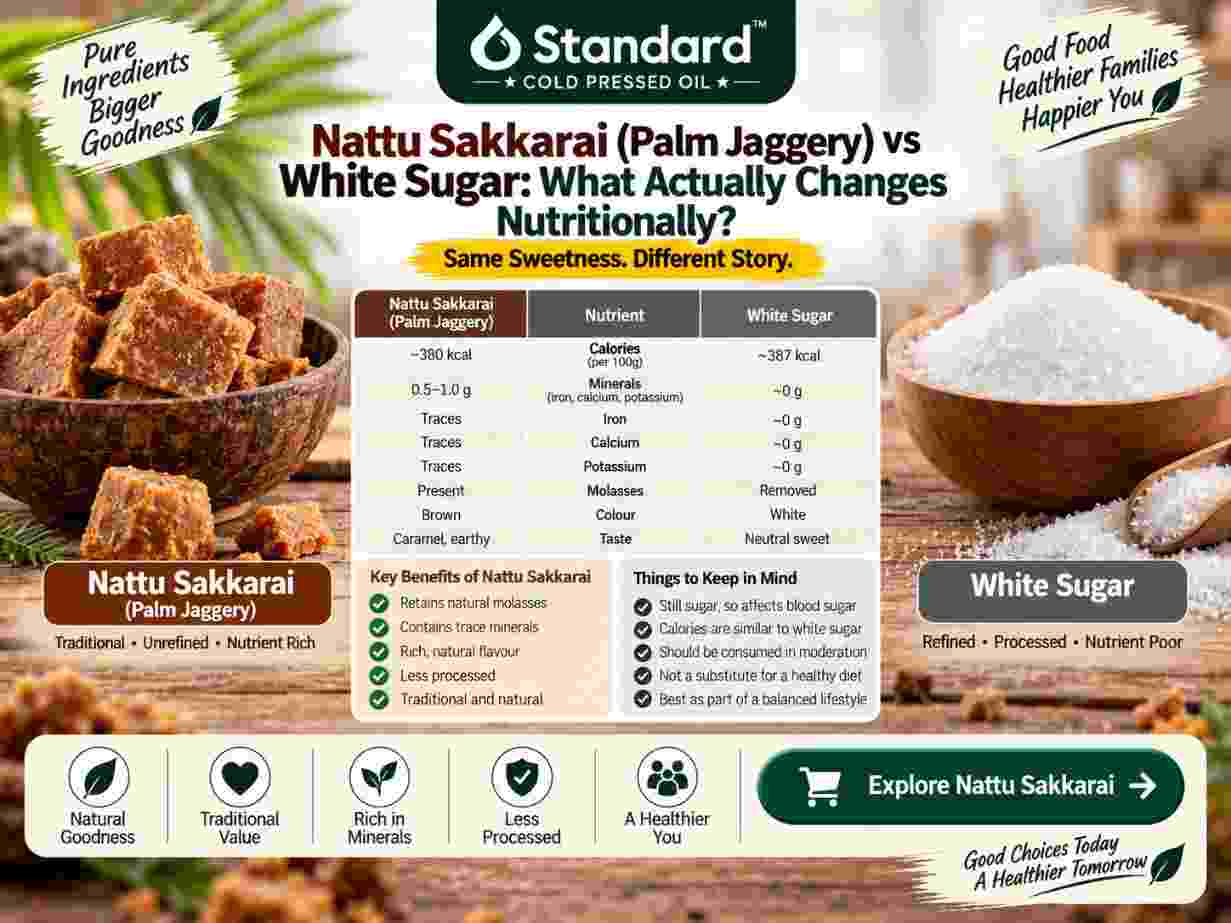
At a Glance
- Nattu sakkarai is unrefined, made by boiling down cane or palm juice and retaining the molasses
- White sugar is refined sucrose, with molasses, minerals, and colour removed through processing
- Nattu sakkarai carries trace minerals like iron and small amounts of calcium and potassium, white sugar does not
- Both raise blood sugar and should be used in moderation, nattu sakkarai is not a free pass for people managing sugar intake
- The flavour difference, caramel, earthy, faintly smoky, is often the more practical reason people prefer it in traditional cooking
Before refined white sugar became the default in Indian kitchens, sweetness came from jaggery, boiled down from sugarcane or palm sap and left largely as nature made it. In many South Indian households it is still called by its older name, nattu sakkarai, country sugar, to distinguish it from the refined kind that arrived later.
The two are not the same product wearing different names. They are made through genuinely different processes, and that difference shows up in flavour, colour, and composition. Here is what actually separates them.
How Each One Is Made
Nattu sakkarai starts as raw cane or palm juice, extracted and then boiled slowly over open heat until the water evaporates and the remaining syrup thickens and crystallises or sets into blocks. Nothing is added, and critically, nothing is removed. The molasses, the dark, mineral-rich liquid that gives jaggery its colour and deep flavour, stays in the final product.
White sugar starts the same way, as cane juice, but the process diverges early. The juice is clarified, and the molasses is spun out through centrifuging, leaving behind pure sucrose crystals. Those crystals are then further bleached and refined until they reach the uniform white colour familiar from any kitchen shelf. What is removed in this process, the molasses, the minerals, the colour, is the entire difference between the two products.
What’s Actually Different in the Final Product
| Aspect | Nattu Sakkarai | White Sugar |
|---|---|---|
| Processing | Boiled and set, unrefined | Refined, molasses removed, bleached |
| Colour | Golden brown to dark amber | White |
| Flavour | Caramel, earthy, mineral notes | Purely sweet, no other flavour |
| Trace minerals | Small amounts of iron, calcium, potassium retained from molasses | Negligible, removed during refining |
| Additives | None in traditionally made nattu sakkarai | Often processed using bleaching or filtering agents |
The mineral content is worth putting in perspective. The amounts of iron or calcium in a typical serving of jaggery are small, and jaggery should not be treated as a significant source of either nutrient on its own. It is a meaningful difference compared to white sugar, which carries essentially none, but it is not a reason to think of jaggery as a health food.
Nattu sakkarai is unrefined sugar, not sugar-free. Both raise blood glucose, and the sensible approach to either is moderation, not substitution as a workaround.
What Nattu Sakkarai Is Traditionally Used For
- Sweetening filter coffee and tea in South Indian households, where its caramel note comes through even in small amounts
- Pongal, both sweet and savoury versions, where jaggery’s flavour is part of the dish’s identity, not just its sweetness
- Traditional sweets like payasam, where the deeper flavour of jaggery is preferred over the flatter sweetness of white sugar
- Everyday sweetening in households that have kept the tradition rather than switching entirely to refined sugar
How to Use It if You Are Switching From White Sugar
Nattu sakkarai dissolves differently than white sugar, more slowly and less completely, particularly in cold liquids, and it brings its own flavour to whatever it sweetens rather than disappearing into the background.
- For hot drinks: dissolve it while the liquid is still hot, it blends far more easily than in something lukewarm
- For baking or desserts: expect a darker colour and a deeper flavour in the final result, this is not a defect, it is the trade-off for using an unrefined sweetener
- Start with a slightly smaller quantity than the sugar a recipe calls for, jaggery’s flavour is more assertive and a straight one-to-one swap can taste stronger than expected
Why Nattu Sakkarai Costs More
Nattu sakkarai is generally more expensive than white sugar, and the reason comes down to yield and time rather than marketing.
Refining sugar is an industrial process built for volume, large batches processed quickly with machinery designed for exactly this output. Making jaggery the traditional way is slower and smaller scale, juice extracted, then boiled down by hand or with simple equipment until it thickens, watched closely so it does not burn or crystallise unevenly. Less juice makes it into the final product per batch, and more labour goes into each one.
There is also a seasonal element. Good quality nattu sakkarai depends on fresh cane or palm juice, which is not available year-round in the same way industrial sugar production is, so supply and pricing can shift with the season and the harvest.
Choosing Good Quality Nattu Sakkarai
- Colour should be a natural golden to dark brown, an unusually uniform, bright colour can indicate added colouring or chemical processing
- It should smell faintly of caramel or molasses, not flat or chemical
- Check the ingredient list, traditionally made nattu sakkarai should list only cane or palm juice, nothing else
| Our nattu sakkarai is made the traditional way, boiled and set with nothing added and nothing refined out. |
Related Reading
- How to Read an Edible Oil Label in India: What the Terms Mean
- Is Cold Pressed Oil Worth the Higher Price? An Honest Look
- Millets 101: A Buyer’s Guide to Choosing the Right Millet for Your Kitchen
Frequently Asked Questions
Is nattu sakkarai a healthier alternative to white sugar for people with diabetes?
Nattu sakkarai still raises blood sugar and should be treated as sugar, not a substitute that removes the need for moderation. Anyone managing diabetes or blood sugar levels should speak with their doctor or a dietitian about how any sweetener, including jaggery, fits into their diet.
Does nattu sakkarai have fewer calories than white sugar?
The calorie content of jaggery and white sugar is broadly similar, gram for gram. The nutritional difference lies mainly in trace minerals and flavour compounds, not in a meaningful calorie reduction.
Why is nattu sakkarai sometimes called palm jaggery and sometimes country sugar?
Both names refer to unrefined jaggery, though palm jaggery specifically comes from palm sap while some nattu sakkarai is made from sugarcane juice. Regional naming varies, and “country sugar” is simply an English rendering of nattu sakkarai used to distinguish it from refined white sugar.
Why does my jaggery sometimes have a slightly salty or sour edge?
This is normal in traditionally made jaggery, and comes from the natural mineral content and slight fermentation that can occur during the slow boiling process. It is part of the flavour profile, not a sign of spoilage, unless accompanied by an off smell or visible mould.
Can I substitute nattu sakkarai for white sugar in any recipe?
In most cases yes, though expect a darker colour and a more pronounced flavour in the final dish. For recipes where a neutral sweetness and pale colour matter, like certain baked goods, white sugar may still be the more practical choice.
