



Quick Answer
Millets are a family of small-seeded grains, foxtail, pearl (bajra), finger (ragi), sorghum (jowar), little, kodo, and barnyard millet among them, each with a different texture, cooking time, and best use. Start with ragi for porridge and dosas, pearl millet for rotis, and foxtail or little millet as an easy rice substitute, then branch out once you know what you are cooking for.
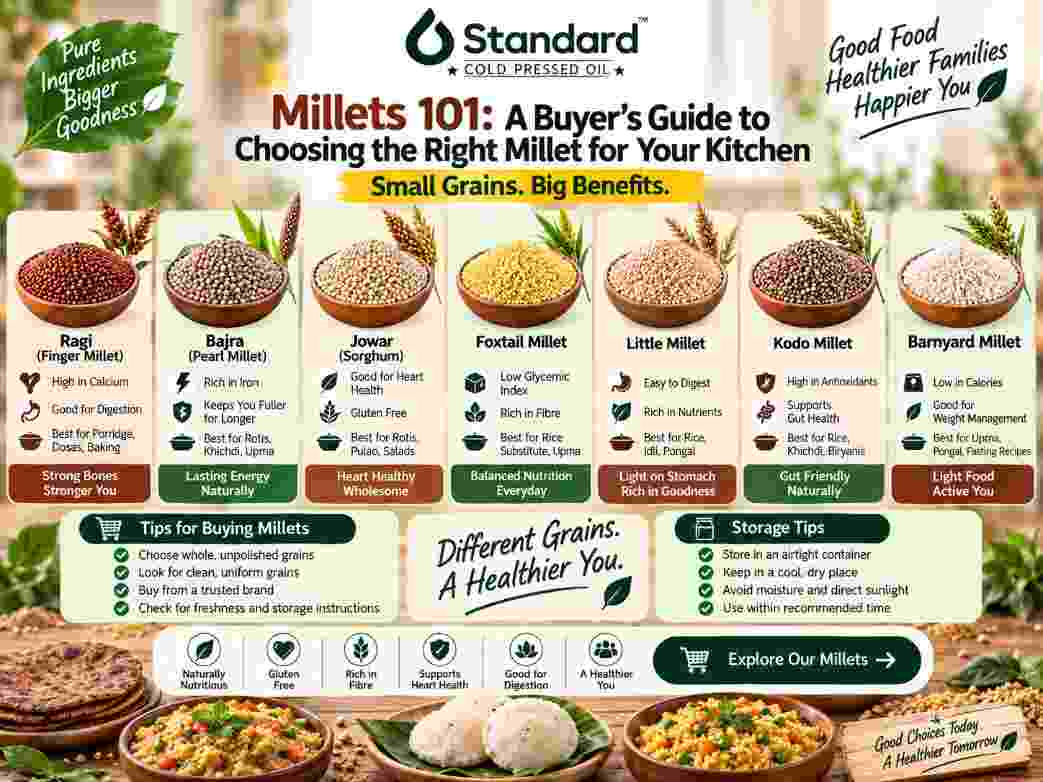
At a Glance
- Millets are not one grain, they are a family of at least seven distinct grains commonly eaten in India, each with different cooking behaviour
- They were the everyday grain across much of India before rice and wheat became dominant through the mid-20th century
- Naturally gluten-free, making them relevant for people avoiding wheat
- Different millets suit different dishes, ragi for porridge, pearl millet for rotis, foxtail and little millet as rice substitutes
- Millet-based convenience foods, noodles, pasta, biscuits, vermicelli, make it easier to introduce millets without changing your whole cooking routine
Millets are having a moment in Indian kitchens again, but for most of the country’s agricultural history, they were never really gone. Before the Green Revolution shifted large parts of India toward rice and wheat monoculture, millets were the everyday grain across the Deccan plateau, Rajasthan, and much of central India, chosen because they grow with little water and tolerate poor soil far better than rice.
What is new is the range of millet varieties now available packaged and ready to cook, and the confusion that comes with it. Walk into a store or browse online and you will see foxtail, pearl, finger, and half a dozen other names, with little guidance on what actually separates them. Here is a straightforward guide.
The Main Millets and What to Do With Them
Finger Millet (Ragi)
Ragi is probably the most recognisable millet in Indian kitchens already, largely thanks to ragi porridge for children and ragi dosa or roti in South Indian households. It has a distinct reddish-brown colour and an earthy flavour. Ragi flour absorbs liquid readily, which makes it well suited to porridges, malt drinks, and flatbreads, though it is dense and works best blended with a little wheat or rice flour if you are new to cooking with it.
Pearl Millet (Bajra)
Bajra is the millet most associated with Rajasthan and Gujarat, where bajra roti is a winter staple, traditionally eaten because the grain is considered warming. It has a slightly sweet, nutty flavour and works well as a flour for rotis and as flakes for a quick breakfast.
Foxtail Millet
Foxtail millet cooks up light and fluffy, closer to rice in texture than most other millets, which makes it the easiest starting point for someone looking to substitute rice without a major adjustment. It works in pulao, upma, and as a plain side the same way rice would.
Little Millet
Little millet, called samai in Tamil, is another rice-like option, slightly smaller grained than foxtail millet, and commonly used in South Indian households for idli, dosa batter, and khichdi-style dishes.
Sorghum (Jowar)
Jowar is a staple across Maharashtra and Karnataka, most familiar as jowar roti or bhakri. It has a mild, slightly sweet flavour and a coarser texture than wheat flour, and it is also increasingly available as pasta and other processed formats for easier everyday use.
Barnyard Millet
Barnyard millet, known as kuthiraivali or samo, cooks quickly and has a light texture, and it is traditionally eaten during religious fasting periods in several parts of India because it is treated as a grain suitable for fasting diets.
Kodo Millet
Kodo millet is less commonly used in everyday cooking but appears in South Indian and tribal cuisines, with a mild flavour that takes on the taste of whatever it is cooked with, similar to how rice behaves in a mixed dish.
There is no single “best” millet. The right one depends on what you are cooking, a roti, a porridge, or a rice substitute all call for a different grain.
How to Choose Where to Start
| If you want to… | Start with |
|---|---|
| Replace rice in everyday meals | Foxtail millet or little millet |
| Make rotis or bhakri | Pearl millet (bajra) or sorghum (jowar) |
| Feed children or make porridge | Finger millet (ragi) |
| Ease in without changing your cooking routine | Millet noodles, pasta, or vermicelli |
Millet Convenience Foods: An Easier Entry Point
Cooking with whole millet grains takes some adjustment, different soaking times, different water ratios, a learning curve most people do not have time for on a weeknight. Millet-based noodles, pasta, and vermicelli solve that problem by keeping the cooking method familiar while changing what the dish is made from.
- Foxtail millet noodles: cook like regular noodles, work in a stir fry or simple noodle soup
- Sorghum (jowar) millet pasta: a straightforward swap in any pasta recipe
- Pearl millet vermicelli: works for both sweet and savoury vermicelli dishes
- Ragi poha (flattened millet flakes): a quick breakfast option closer to regular poha in preparation time
Practical Cooking Notes
- Rinse whole millet grains before cooking, the same way you would rinse rice, to remove surface starch and any dust from processing
- Most whole millets benefit from a short soak, twenty to thirty minutes, before cooking, which shortens cooking time and improves texture
- Store millet flour in an airtight container and use it within a few weeks, whole grain flours turn stale faster than refined flours
- If a millet dish tastes bland the first time, it usually needs more tempering or spice than a rice or wheat dish would, millets carry flavour differently
| We carry a range of unpolished millets and millet-based noodles, pasta, and snacks, sourced traditionally processed and without added preservatives. |
Related Reading
- Nattu Sakkarai (Palm Jaggery) vs White Sugar: What Actually Changes Nutritionally?
- Which Oil Is Best for Indian Cooking? A Practical, Region-by-Region Guide
- How to Read an Edible Oil Label in India: What the Terms Mean
Frequently Asked Questions
Are millets gluten-free?
Yes, millets are naturally gluten-free grains. If you are cooking for someone with celiac disease or a gluten allergy, still check that any packaged millet product, particularly flours and processed foods, is processed in a facility that avoids cross-contamination with wheat.
Which millet is closest to rice in taste and texture?
Foxtail millet and little millet are generally considered the closest to rice, both in how they cook up light and separate, and in how mild their flavour is, making them the easiest substitution for people who eat rice daily.
Do millets need to be soaked before cooking?
Most whole millet grains cook better with a short soak of twenty to thirty minutes, which softens the grain and reduces cooking time. Millet flour and processed millet products like noodles or vermicelli do not need soaking.
Can millets replace rice and wheat completely in a diet?
Millets can replace rice and wheat in many dishes, but any significant dietary change, especially for children, older adults, or anyone with an existing health condition, is worth discussing with a doctor or dietitian rather than making the switch all at once.
Why do some millets taste bitter?
A mild bitterness in some millets, particularly older or improperly stored stock, usually indicates the grain has started to oxidise. Fresh, well-stored millet should taste mild and slightly nutty, not bitter, so check the packaging date when buying.
